A person is having trouble whilst washing their face during Wudu, due to the eczema, what should they do in this case? Jazakallah
Answer:
In the Name of Allah, the Most Gracious, the Most Merciful.
As-salāmu ‘alaykum wa-raḥmatullāhi wa-barakātuh.
If an individual is unable to wash a limb required for wuḍūʾ due to harm or injury or that wetness may delay healing (based on personal experience or the advice of a doctor), then they should act according to what is possible, and their wuḍūʾ will remain valid. This is done as follows:
If washing the limb is harmful, they should wipe over the limb, provided wiping does not cause harm.
If wiping the injured limb itself is also harmful, then they should wipe (masaḥ) over the bandage or dressing covering that limb, as wiping over a dressing is permitted when direct contact would cause harm.
If wiping (masah) over the bandage is likewise harmful or not possible, the limb is excused and omitted, and the wuḍūʾ remains valid.[1]
If the majority of the body parts that are required to be washed in wuḍūʾ are such that wetness may cause harm or delay healing, such that they cannot be washed, then it is permitted to perform tayammum.[2] In such a case, one will not resort to wiping (masah) of the body parts, instead one will do tayammum.
And Allah Ta’āla Knows Best
Answered by
Habib Ullah Khan
Checked & Approved By:
(Mufti) Muadh Chati
[1] (ويجمع) مسح جبيرة رجل (معه) أي مع غسل الأخرى لا مسح خفها بل خفيه. (ويجوز) أي يصح مسحها (ولو شدت بلا وضوء) وغسل دفعا للحرج (ويترك) المسح كالغسل (إن ضر وإلا لا) يترك (وهو) أي مسحها (مشروط بالعجز عن مسح) نفس الموضع (فإن قدر عليه فلا مسح) عليها. والحاصل لزوم غسل المحل ولو بماء حار، فإن ضر مسحه، فإن ضر مسحها، فإن ضر سقط أصلا. (در المختار)
(قوله لا مسح خفها إلخ) أي لا يجمع مسح جبيرة رجل مع مسح خف الأخرى الصحيحة؛ لأن مسح الجبيرة حيث كان كالغسل يلزم منه الجمع بين الغسل والمسح، بل لا بد من تخفيف الجريحة أيضا ليمسح على الخفين، لكن لو لم يقدر على مسح الجبيرة له المسح على خف الصحيحة صرح به في التتارخانية: أي؛ لأنه كذاهب إحدى الرجلين (قوله بلا وضوء وغسل) بضم الغين بقرينة الوضوء، وهذا هو الثالث، ولا يتكرر على قوله الآتي، والمحدث والجنب إلخ؛ لأن هذا فيما إذا شدها على الحدث أو الجنابة، وذاك فيما إذا أحدث أو أجنب بعد شدها أفاده ح (قوله ويترك المسح كالغسل) أي يترك المسح على الجبيرة كما يترك الغسل لما تحتها، وهذا هو الرابع ح (قوله إن ضر) المراد الضرر المعتبر لا مطلقه؛ لأن العمل لا يخلو عن أدنى ضرر وذلك لا يبيح الترك ط عن شرح المجمع (قوله وإلا لا يترك) أي على الصحيح المفتى به كما مر (قوله وهو إلخ) هذا الخامس (قوله عن مسح نفس الموضع) أي وعن غسله، وإنما تركه؛ لأن العجز عن المسح يستلزم العجز عن الغسل ح (قوله ولو بماء حار) نص عليه في شرح الجامع لقاضي خان، واقتصر عليه في البدائع، وقيده بالقدرة عليه. وفي السراج أنه لا يجب والظاهر الأول بحر
حاشية ابن عابدين: 2/234-236 ط. دار السلام
قوله: (وَإِلا لا يُتْرَكُ) قال في البحر) عن المحيط» إذا زادت الجبيرة على رأس الجرح إن كان حل الخرقة وغسل ما تحتها يضر بالجراحة يمسح على الكل تبعًا، وإن كان الحل والمسح لا يضران بالجرح لا يجز به مسح الخرقة، بل يغسل ما حول الجراحة، ويمسح عليها لأعلى الخرقة، وإن كان يضره المسح، ولا يضره الحل يمسح على الخرقة التي على رأس الجرح، ويغسل حواليها، وتحت الخرقة الزائدة إذ الثابت بالضرورة يتقدر بقدرها، ولو ضره الحل لا المسح يمسح كما صرح به في «الدرر». قوله: (وهو مشروط … إلخ) هو الخامس قوله: (عن مسح نفس الموضع) والعجز على المسح يستلزم العجز عن الغسل حلبي قوله: (فإن قدر عليه) أي: على مسح نفس الموضع، وعجز عن غسله قوله: (فلا مسح عليها) أي: صحيح. قوله: (ولو بماء حار) في الشرنبلالية عن قاضي خان» إن كان لا يضره غسل ما تحتها يلزمه الغسل، وإن كان يضره الغسل بالماء البارد لا بالحار يلزمه الغسل بالماء الحار؛ أي إن قدر عليه قاله الكمال. قال الشارح: قوله: (فإن ضر) أي: غسله، ولو بماء حار مسحه افتراضا، فإن ضر مسحه مسح الجبيرة افتراضا قوله: على كل عصابة) الصواب أن يقال: على كل العصابة؛ لأن كلا إذا دخلت على منكر، أفادت استغراق الأفراد، وإذا دخلت على معرف أفادت استغراق الأجزاء والمقصود الثاني، ثم إن المصنف تبع الكنز) في ذلك، والأصح الذي عليه الفتوى الاكتفاء بمسح الأكثر. قال في «البحر»: وكان ينبغي للمصنف أن يقول: ويمسح على أكثر العصابة ونحوها، وإن لم يكن تحتها جراحة إن ضره الحل، انتهى، وهل الدواء كالجبيرة في هذا الحكم؟ يحرر، أفاده الحلبي.
حاشية الطحطاوي على الدر المختار: 1/144 ط. مكتبه رشيديه
“وإن كان أكثره صحيحا غسله” أي الصحيح “ومسح” الجريح” بمروره على الجسد وإن لم يستطع فعلى خرقة وإن ضره تركه وإذا كان الجراحة قليلة ببطنه أو ظهره ويضره الماء صار كغال الجراحة حكما للضرورة “ولا” يصح أن “يجمع بين الغسل والتيمم” إذ لا نظير له في الشرع للجمع بين البدل والمبدل والجمع بين التيمم وسؤر الحمار لإداء الفرض بأحدهما لا بهما كما لا يجتمع قطع وضمان وحد مهر ووصية وميراث إلى غير ذلك من المعدودات هنا.
مراقي الفلاح شرح نور الإيضاح: 52 ط. دار الكتب العلمية
ولو كان أكثر بدنه صحيحا وأقله جريحا ثم أجنب أو أحدث غسل الصحيح ومسح الجريح إن لم يضره، وعلى الخرقة إن ضره وتيمم لو كان عكسه
فتح باب العناية بشرح النقاية: 1/103 ط. دار الكتب العلمية
[2] 569 – وإذا كان عامة بدن الجنب جريحًا، أو عامة أعضاء المحدث، فإنه يتيمم ولا يستعمل الماء فيما كان صحيحاً. وإن كان على العكس، فإنه يغسل ويمسح على الجراحة إن أمكنه، أو فوق الخرقة إن كان المسح يضره، ولا يتيمم، وهو قول علماءنا رحمهم الله تعالى.
المحيط البرهاني: 1/314 ط. المجلس العلمي
إذا كان عامة بدن الجنب أو عامة أعضاء المحدث جريحاً يتيمم. وعلى عكسه يغسل الصحيح. ويمسح الجريح أو الخرقة إن لم يضره المسح.
المجتبى شرح مختصر القدوري: 1/86 ط. دار الرياحين
وإذا كان عامة بدن الجنب جريحا وشيء منه صحيحا، أو عامة أعضاء المحدث جريحا وشيء منه صحيحا، فإنه يتيمم ولا يستعمل الماء فيما كان صحيحا، وإذا كان على العكس فإنه يغسل ماكان صحيحا ويمسح على الجراحة إن أمكنه أو فوق الخرقة إن كان المسح يضره ولا يتيمم، وهو قول علمائنا،
الفتاوي التاتارخانية: 1/380 ط. مكتبة فاروقية
(ولا يجمع بين الوضوء والتيمم) لما فيه من الجمع بين الأصل والخلف بخلاف الجمع بين التيمم وسؤر الحمار؛ لأن الغرض يتأدى بأحدهما لا بهما فجمعنا بينهما لمكان الشك (فإن كان أكثر الأعضاء) أي أكثر أعضاء الوضوء (جريحا) في الحدث الأصغر أو أكثر جميع بدنه في الحدث الأكبر (يتيمم) ولا يجوز أن يغسل الصحيح ويمسح الجريح. (وإلا) أي وإن لم يكن أكثر الأعضاء جريحا بل مساويا أو أكثر الأعضاء صحيحا (غسل الصحيح ومسح على الجريح) إن لم يضره وإلا فعلى الخرقة، ولا يجوز التيمم؛ لأن للأكثر حكم الكل.
مجمع الأنهر في شرح ملتقى الأبحر: 1/67 ط. دار الكتب العلمية
فإن كان أكثر أعضاء الوضوء جريحاً تيمَّم ولم يستعمل الماء، وإن كان أكثر أعضائه صحيحاً، غسل الصحيح ويمسح الجراحة إن أمكنه مسحه من غير ضرر، حتى لو كانت الجراحة على رأسِه ووجهه ويدِه وليس على رجليه جراحة يُباح له التيمم، وعلى عكسه لا يباح، وقيل: يعتبر الكثرة في الأعضاء حتى لو كان على رأسه ووجهه ويديه جراحة وليس على رجليه جراحة لا يباح له التيمم إذا لم يكن الأكثر من كلّ عضو جريحاً.
فتاوي قاضي خان: 1/39 ط. دار الفكر
قوله: (وإلا تيمم) أي وإن لم يكن له ثمنه تيمم لتحقق العجز قال – رحمه الله – (ولو أكثره مجروحا تيمم) أي ولو كان أكثر أعضاء الوضوء منه مجروحا في الحدث الأصغر أو أكثر جميع بدنه مجروحا في الحدث الأكبر تيمم؛ لأن للأكثر حكم الكل قال – رحمه الله – (وبعكسه يغسل) أي إذا كان الصحيح أكثر من المجروح يغسل لما قلنا.
تبيين الحقائق: 1/136 ط. دار الكتب العلمية
– فلو كان جميع بدنه مجروحاً أو مقروحاً ويضره الماء، فإنه يتيمم، وفي حال الوضوء ينظر إلى عدد أعضاء الوضوء، حتى لو كان رأسه ووجهه ويداه مجروحة دون رجليه مثلاً، فإنه يتيمم، وفي العكس لا يجوز له التيمم، بل يغسل الصحيح ويمسح الجريح، وإذا كان المسح يضره يمسح فوق الضماد وفي الغسل ينظر إلى مساحة المجروح، فإذا كان أكثر البدن مجروحاً يتيمم، وبالعكس يغسل الصحيح ويمسح على الجريح كما تقدم. وهذا إذا كان يمكنه غسل الصحيح بدون إصابة الجريح، فلو كانت الجراحة بظهره مثلاً، وإذا صب الماء على رأسه سال عليها، يكون ما فوق الجراحة كحكمها. وإن كان الصحيح والجريح متساويين، فالأحوط غسل الصحيح ومسح الجريح. ويتيمم من كانت الجراحة في يديه، ولا يمكنه غسل وجهه وقدميه، ولا يجد من يوضئه.
الفقه الحنفي في ثوبه الجديد: 1/158-159 ط. دار القلم
If a person gave adhan in one masjid and read salah there, then went to a second masjid and gave adhan there for the same salah, it would be makrooh.
But what if he gave adhan in the first masjid and didn’t read salah there and instead also gave adhan in a second masjid? Some say this scenario is also makrooh, and others say this is permissible. Can you please clarify what the correct position is in this regard?
Answer:
In the Name of Allah, the Most Gracious, the Most Merciful.
As-salāmu ‘alaykum wa-raḥmatullāhi wa-barakātuh.
The underlying rule is that it is considered makrūh (disliked) for a person to give the adhān and leave the masjid without any valid reason.
If a person gives the adhān in one masjid and performs the ṣalāh there, thereafter he leaves to give the adhān in another masjid for the same ṣalāh, this is deemed makrūh.[i]
However, some jurists state that if the ṣalāh was not performed in the first masjid, and he goes to another masjid for a valid reason such as the congregational prayer not taking place without him, or because he is the mu’adhin there, or the only imam etc, then it is not disliked for him to leave[ii].
And Allah Ta’āla Knows Best
Answered by:
Shabbir Dewan
Checked & Approved By:
(Mufti) Muadh Chati
[i] ويكره أن يؤذن في مسجدين، ويصلي في أحدهما ؛ لأنه إذا صلى في المسجد الأول – يكون متنفلاً بالأذان في المسجد الثاني، والتنفّل بالأذان غير مشروع؛ ولأن الأذان يختص بالمكتوبات، وهو في المسجد الثاني يصلي النافلة، فلا ينبغي أن يدعو الناس إلى المكتوبة وهو لا يساعدهم فيها . بدائع الصنائع ١/٦٤٨ ط.دار الكتب العلمية وحاشية ابن عابدين ٢/٦٣٤ ط.دار السلام
ويكره أن يؤذن في مسجدين لأنه يكون في إحداهما داعيًا إلى ما لا يفعل. غنية المتملي ٢/٢٧٠ ط.الجامعة الاسلامية: دار العلوم ديوبند
قال : (ويكره أن يؤذن في مسجدين ويصلي في أحدهما) لأنه بعد ما صلى يكون متنفلاً بالأذان في المسجد الثاني والتنفل بالأذان غير مشروع ولأن الأذان مختص بالمكتوبات فإنما يؤذن ويقيم من يصلى المكتوبة على أثرهما، وهو في المسجد الثاني يصلى النافلة على أثرهما.كتاب المبسوط١/٢٨٦ ط.دار الكتب العلمية
[ii]) وكره خروجه من مسجد أذن فيه (أو في غيره )حتى يصلي (لقوله صلى الله عليه وسلم” :لا يخرج من المسجد بعد النداء إلا منافق أو رجل يخرج لحاجة يريد الركوع) “إلا إذا كان مقيم جماعة أخرى (كإمام ومؤذن لمسجد آخر لأنه تكميل معنى. مراقي الفلاح ٣٨٨
قوله : (وكره خروجه) أي تحريماً للنهي بالحديث المذكور… قوله : (كإمام) قيده في الكبير، وشرح السيد، وغيرهما بإمام تتفرق الناس بغيبته فيفيد أنه لو لم يكن بهذه المثابة لا يخرج، والظاهر أن المؤذن إذا كان من يقوم مقامه عند غيبته يكره له الخروج أيضاً. حاشية الطحطاوي على مراقي الفلاح ٤٥٧ ط.دار الكتب العلمية
اگر اس شخص پر دوسری مسجد کی جماعت کا توقف ہے کہ اگر یہ نہ جائے تو وہاں جماعت نہ ہو تب اس کو دوسری جگہ نماز پڑھنا مکروہ نہیں، وہیں جا کر نماز پڑھے، اگر اس پر توقف نہیں تو ایسی حالت میں مسجد سے نکلنا بلا ضرورت مکروہ ہے . فتاوی محمودیہ ٥/٤٣٧ط.ادارہ الفاروق کراچی
اگر دوسری مسجد میں جماعت کا انتظام اس سے متعلق ہے تو جانا جائز ہے، ورنہ مکروہ ہے ۔ آپ کے مسائل اور ان کا حل ٣/٣١٦ ط.مکتبہ لڈھیانوی
I have a query regarding the following, A friend of mine sells high value goods. To make it easy for customers, the customer has two options to pay for the goods:
1. Cash
2. Debit / Credit Card
3. EFT
If customer chooses to pay by debit / credit card, a 2% service fee is added to the invoice to cover the bank commission fee charged to seller. If customer chooses to pay by EFT, a higher price is charged by seller as seller is required to pay bank charges to withdraw the cash from the account again. Is this permissable from a shariah perspective? If this is not permissible, will it be permissible to quote the customer for the same goods a cash price and a different price form credit card or EFT?
Answer:
In the Name of Allah, the Most Gracious, the Most Merciful.
As-salāmu ‘alaykum wa-raḥmatullāhi wa-barakātuh.
Muhtaram Ulama,
The use of the credit card terminal is a norm. The seller is paid lesser than the value of the purchase price.
Where did the balance of the amount go?
Who took it?
Why?
Who are the role players between the seller and purchaser?
This complex issue has been thorougly researched by my able student, Moulana Maaz Chati which makes an interesting academic read.
May Allah Ta’ala increase Moulana Muadh in his Uloom. Ameen.
Ebrahim Desai
Hereunder are the details and procedures of a credit card transaction[1].
The individuals and institutions involved in a credit card transaction:
The Merchant: the individual selling the commodity.
The Customer: the individual buying the commodity.
The Card Issuing Bank: the Institution that has issued the card to the Customer and will pay for the commodity on behalf of the Customer.
The Acquiring Bank/Processor: the Institution that will acquire the payment for the commodity from the Card Issuing Bank on behalf of the Merchant.
The Merchant Account: this is the bank account of the Merchant. Once the Acquiring Bank/Processor gains posession of the payment from the Card Issuing Bank, the Acquiring Bank/Processor will deposit this payment into the Merchant’s account.
The Network: this is the organisation that liases between the Card Issuing Bank and Acquiring Bank/Processor.
EXAMPLE: VISA, MasterCard, American Express, Discover, etc.
The Fees
There are also 4 fees involved in the entire process[2]:
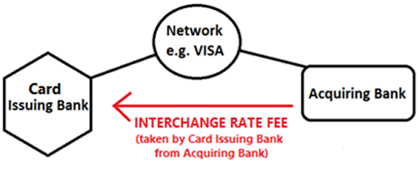
Interchange Fee: this is a fee taken by the Card Issuing Bank from the Acquiring Bank/Processor and remains constant for 6 months[3].
Network Fee: this is a fee taken by the Network (e.g. VISA) from the Acquiring Bank/Processor and remains constant.
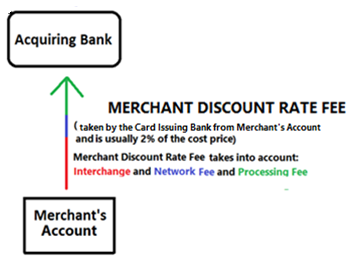
Merchant Discount Rate Fee: this is a fee charged by the Acquiring Bank/Processor to the Merchant and covers up for the Interchange Fee and Network Fee paid by the Acquiring Bank/Processor and includes a Processing Fee.
Processing Fee: It is a part of the Merchant Discount Rate Fee and is charged by the Acquiring Bank/Processor to the Merchant. This charge varies in Tiered Pricing and remains constant[4] in Interchage Plus Pricing.
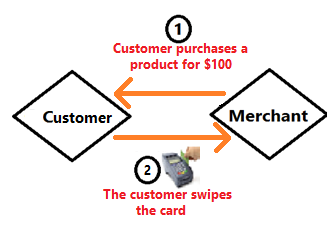
A transaction occurs between a Customer and a Merchant for a product that has a fee of $100,
The Customer swipes his credit card in the electronic terminal,
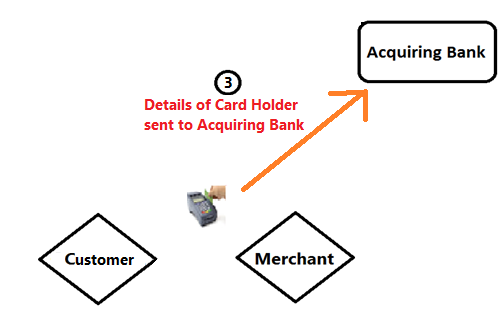
The Customer’s credit card details are sent to the Acquiring Bank/Processor,
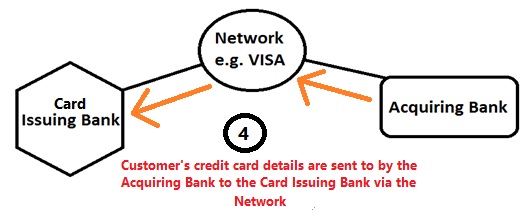
The Acquiring Bank/Processor sends the Customer’s credit card details to the Card Issuing Bank via the Network,
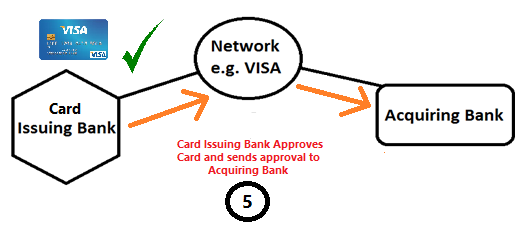
The Card Issuing Bank approves the Customer’s credit card and sends its approval to the Acquiring Bank/Processor,
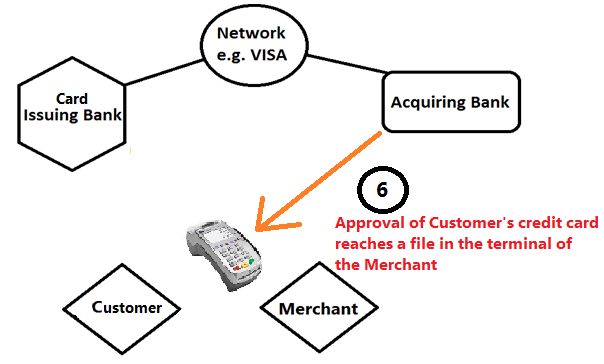
The approval of the Customer’s credit card reaches the Merchant’s terminal and is stored in a file within the terminal,[6]
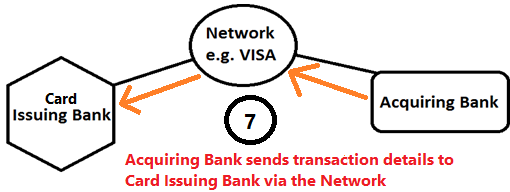
The Acquiring Bank/Processor sends the details of the transaction to the Card Issuing Bank through the Network,
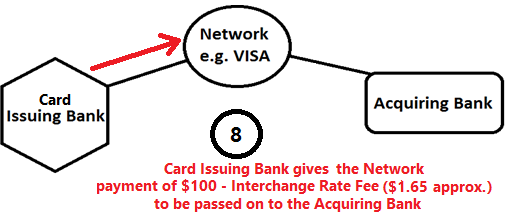
The Card Issuing Bank assesses the $100 payment and deducts approximately $1.65 as Interchange Fee, the remaining amount which is approximately $98.35 is then passed onto the Network and the Network will be required to pass on this amount to the Acquring Bank/Processor,
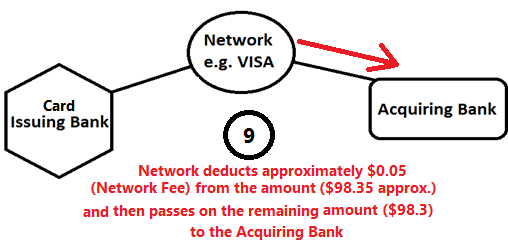
The Network deducts $0.05 (approx.) as a Network Fee from this remaining amount ($98.35 approx.), thus the Acquiring Bank/Processer receives approximately $98.3. The Acquiring Bank/Processor has lost $1.70 from the due payment of $100 due to the Interchange Fee and Network Fee,
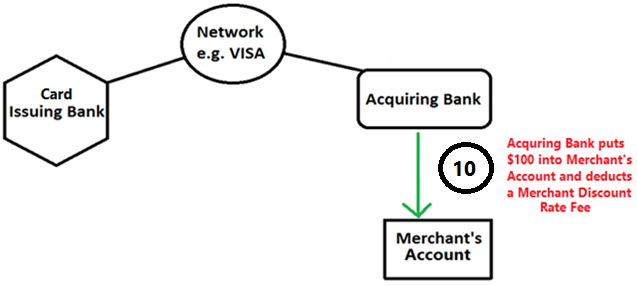
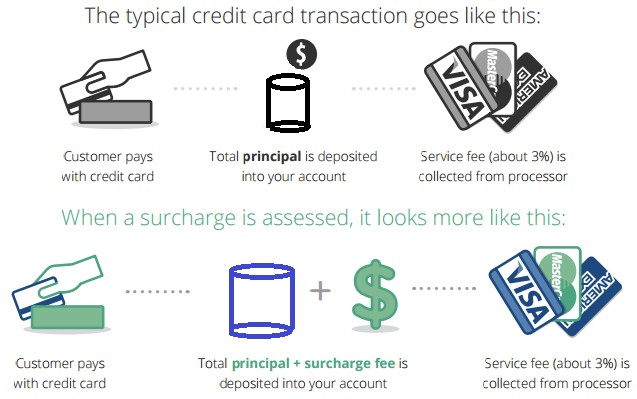
The Merchant sends the terminal file to the the Acquiring Bank/Processor. The Acquiring Bank/Processor deposits $100 into the Merchant Account and deducts $2.00 (approx.) (approximately 2% of $100). This deduction of $2.00 (approx.) is a fee known as the Merchant Discount Rate Fee.[7]
Now, let us revisit the Fees that have been discussed:
There are 4 fees involved in the entire process[8]:
Interchange Fee: this is a fee charged by the Card Issuing Bank to the Acquiring Bank/Processor and remains constant for 6 months[9] (see point 8 above).
Network Fee: this is a fee charged by the Network (e.g. VISA) to the Acquiring Bank/Processor and remains constant (see point 9 above).
Merchant Discount Rate Fee (Approximately 2%): this is a fee charged by the Acquiring Bank/Processor to the Merchant and covers up for the Interchange Fee and Network Fee paid by the Acquiring Bank/Processor and includes a Processing Fee.
Processing Fee: It is a part of the Merchant Discount Rate and is charged by the Acquiring Bank/Processor to the Merchant[10] (see point 10 above).
A Summarised Version of the Above Procedure
Customer buys a product,
Customer swipes his credit card into the Merchant’s electronic terminal,
Details of the credit card are sent to the Acquiring Bank,
The Acquiring Bank sends the details of the credit card to the Card Issuing Bank through the Network,
The Card Issuing Bank approves the credit card,
The approval of the credit card is sent to the Merchant’s electronic terminal,
The Acquiring Bank now sends the details of the transaction to the Card Issuing Bank through the Network,
The Issuing Bank deducts a portion of the payment as Interchange Fee and delivers the balance to the Network,
The Network further deducts a portion from the balance as a Network Fee and delivers the remaining amount to the Acquiring Bank,
The Acquiring Bank transfers the payment to the Merchant’s account and deducts a percentage of the payment as a Merchant Discount Rate Fee.
The 2% Commission Fee (Merchant Discount Rate Fee)
It has been understood from the above that the 2% (approx.) charge paid by the Merchant to the Acquiring Bank/Processor is known as a Merchant Discount Rate Fee.
The Merchant Discount Rate Fee is made up of three components[11]:
Interchange[12][13][14] (the charge that the Acquiring Bank/Processor has paid to the Issuing Bank)
+ Network Fee[15] (the charge that the Acquiring Bank/Processor has paid to the Issuing Bank)
+ Processing Fee (added by the Acquiring Bank/Processor for its services)
Thus, the Merchant Discount Rate Fee is augmented due to the Interchange Fee[16] and Network Fee within.[17][18][19]
The reasons behind each charge
The Interchange Fee is charged by the Issuing Bank to the Acquiring Bank/Processor for the following reasons:
Bearing credit risk,
Fraud protection,
Benefits provided to the Merchant through the card.
The Network Fee is charged by the Network to the Acquiring Bank/Processor for the following reasons:
Providing a platform for the transaction,
Bearing risk, etc.
The Merchant Discount Rate Fee is charged by the Acquiring Bank/Processor to the Merchant for the following reasons[20]:
Acceptance of one or more payment brands,
Account services,
Terminal purchase or rental and ongoing maintenance, (this may be charged as a seperate invoice)[21]
Security upgrades,
Fraud risk management,
Interchange,
The use of data transmission lines,
Transaction slips and other card supplies,
Point-of-sale materials,
Acquirer’s profit margin.
The Shari’ah perspective
In principle, all costs incurred for the transfer of payment must be borne by the Customer[22] and all cost incurred for the delivery of the commodity must be borne by the Merchant.[23]
As mentioned above, the Merchant Discount Rate Fee is levied on the Merchant in lieu of various services provided to the Merchant.[24]Hence, it is not permissible for the Merchant to levy this charge onto the Customer.[25]
However, if it is the norm/common practise (urf – عرف) of the people of a region and sector[26] (such as some parts of the USA[27][28] and countries such as Australia[29]) to levy the Merchant Discount Rate Fee (2% approx.) upon the customer[30], then this would be permissible.[31]
However, the laws of the country wherein this is practised must be followed.[32]
Alternatively, the Merchant may increase the cost price of all products and then offer a discount to those who pay in cash in order to cover costs.[33]
Final Comments
It is important to understand that the concept of adding a service fee[34] to the invoice of the customer as proposed in the question has been considered illegal in some countries.[35][36] We must abide by the laws of the country in which we reside.[37]
As for increasing the cost price of products that are bought with a credit card/debit card/EFT at the time of sale as alluded towards in the question, this will be permissible[38] on the condition that the law of the country permits it.[39]
Alternatively, the Merchant may increase the cost price of all products[40] and then offer a discount to those who pay in cash; this is permissible[41] and is also legal.[42]
And Allah Ta’āla Knows Best
Answered by:
(Mufti) Muadh Chati
Checked & Approved By:
Mufti Ebrahim Desai.
[1]Debit cards and credit cards work in similar ways. Both carry the logo of a major credit card company, such as Visa or MasterCard, and can be swiped at retailers to purchase goods and services.
THE KEY DIFFERENCE BETWEEN THE TWO CARDS IS WHERE THE MONEY IS DRAWN FROM WHEN A PURCHASE IS MADE. WHEN A CONSUMER USES A DEBIT CARD, THE MONEY COMES DIRECTLY FROM HIS CHECKING ACCOUNT. WHEN HE USES A CREDIT CARD, THE PURCHASE IS CHARGED TO A LINE OF CREDIT FOR WHICH HE IS BILLED LATER.
Consider two customers who each purchase a television from a local electronics store at a price of $300. One uses a debit card, and the other uses a credit card. The debit card customer swipes his card, and his bank immediately places a $300 hold on his account, effectively earmarking that money for the television purchase and preventing him from spending it on something else. Over the next one to three days, the electronics store sends the transaction details to the bank, which electronically transfers the funds to the store.
The other customer uses a traditional credit card. When he swipes it, the credit card company automatically adds the purchase price to his outstanding balance. With most credit card companies, the customer has 30 days to pay before interest is charged on the outstanding balance. Interest rates on credit cards are notoriously high. Savvy consumers avoid paying credit card interest in two ways. One, they pay their balance in full each month and never allow it to carry over beyond the 30-day mark. Two, they use a debit card instead of a credit card and only spend money they have in their accounts.
Think of credit as borrowed money. This money is made available to you, but it must be repaid within an agreed amount of time. Credit cards provide a line of revolving credit. This differs from charge cards, which require that the balance is paid at the end of the month.
[2]Network Fees/Assessments are the fees charged by the Networks (MasterCard and Visa) to facilitate the transactions through their systems. They charge basis points of the transaction in the range of around 0.05% with fluctuations of several basis points in either direction.
Acquirer/Processor fees are charged by the merchant processor/acquirer and are highly variable. They are normally in the 10s of basis points (ie .10%-.70%) as a percentage of a transaction.
In a hypothetical example Chase is the card issuer, Visa is the network, First Data is the processor/acquirer. Transaction value of $100 with a merchant discount of 2%. The merchant only has to pay that 2% (they will pay that to their processor, First Data in this case). That processor passes this information to Visa who then allocates the $2.00 the following ways.
Interchange (assume 1.65%) –> $1.65 to Chase (set by Visa based off of the credit card used in the transaction)
Network Fee (assume 0.05%) –> $0.05 to Visa
Processor/Acquirer Fee (assume 0.30% –> $0.30 to First Data
This is very high level. More parties often charge additional fees such as gateways and additional types of merchant processors making the dynamics of a transaction layered with many companies each taking a sliver. Additionally the interchange levels set by the networks are complex documents with discounts, fees and assessments applied to various merchant classes, geographies and card types
Retailers and consumers do not pay interchange. Interchange is the transfer rate exchanged between the retailer’s and cardholder’s financial institutions each time a Visa payment product is used. The retailer’s financial institution, or acquirer, generally pays interchange. Retailers make a payment to their financial institution for Visa card transactions, frequently referred to as a Merchant Discount Rate (MDR). This is a market-based fee set by each acquiring financial institution operating in a competitive marketplace—retailers can choose their financial institution in the same way cardholders can choose the financial institution that issues their Visa card.
Interchange plus pricing means that the provider charges a set fee — say 0.10 percent + $0.05 — over the interchange rate (the fees that go to the bank that issued the card used to purchase the goods and services) and the pass-through fees (the fees charged by the card companies).
The advantage of interchange plus pricing is that you have a processing rate that is determined up front. If an interchange rate is adjusted up or down, it automatically takes effect and will only affect the rate on a few of the cards. With no hidden costs and a statement you can actually understand, you will be receiving the most competitive pricing available and it’ll be easier for you to compare to the other processors.
With true interchange plus pricing, the actual costs are passed through to the merchant and all the costs of the processing are disclosed for the merchant to see, including interchange and the dues and assessment costs, the processor will then work with the merchant to establish the discount rate.
There are two main kinds of pricing merchant service providers use, interchange plus and tiered.
Interchange Plus
An interchange plus pricing model, is basically just a markup model. The merchant service provider adds up the interchange and card brand fees for a transaction and then adds their standard markup rate on top of that. The markup rate does not change based on card provider or type, making it a pretty transparent pricing model.
A cardholder selects his or her goods, agrees to pay the retail price to the retailer and presents his or her card for payment.
The retailer submits the purchase details, including the Visa card information, to its acquiring financial institution for approval.
The acquiring financial institution sends the purchase details to the cardholder’s financial institution.
Assuming it has correctly followed the procedures required by its acquiring financial institution, the retailer receives a “payment guarantee,” and the cardholder receives the goods.
The cardholder’s financial institution remits to the retailer’s acquiring financial institution the retail price less the interchange rate. This interchange rate may be a unique rate that has been negotiated directly between the cardholder’s and retailer’s financial institutions, or it may be the default rate that is set by Visa.
Visa is not involved in any way with negotiating or setting the MDR.
(According to what is understood from Visa, the Interchange Fee is paid by the Acquiring Bank before the Merchant Discount Rate is taken from the Merchant. However, other websites show that the Interchage Fee is paid by the Acquiring Bank after the Merchant Discount Rate is taken from the Merhcant:
In the first step, the merchant sends its transactions to its merchant acquirer. The merchant acquirer sends this information to the merchant accounting system (MAS) servicing that particular merchant’s account. In some cases, the MAS is a part of the merchant acquirer; in others, it is a different entity. The MAS distributes the transactions to the appropriate network—Visa transactions to the Visa network, MasterCard transactions to the MasterCard network, and so forth.6 Next, the MAS deducts the appropriate merchant discount fee (to cover the costs of the merchant acquirer’s activities) from the transaction amount and generates instructions to remit the difference to the merchant’s bank for deposit into the merchant’s account. The MAS sends these instructions to the automated clearinghouse (ACH) network, which is a computer-based system used to process electronic transactions between participating depository institutions.
To recover these funds, the MAS sends information about the merchant’s transactions to Interchange, which is part of the Visa or MasterCard network. Interchange is the clearing and settlement sytem that transfers data between the card processor and the issuing bank. Interchange determines the interchange fee and Visa/MasterCard assessments (to cover the cost of the issuing bank’s services and the network’s costs) and sends the information to the card-issuing bank. In turn, the issuing bank remits the transaction amount, less the interchange fee, to Interchange, which passes it on to the MAS. Finally, the issuing bank bills the cardholder and collects the balance.
[6]So what really occurs when you make a purchase? Well, the credit card transaction often takes place within a minute, but it’s actually a complex process. When the credit card is swiped through an electronic terminal or sales unit, the credit card account’s information is read. The process of authorization can take place several ways but, generally, once it is read a request is sent for the authorization of the sale to the acquiring bank. The acquiring bank then sends the request to the cardholder’s issuing bank or card association, such as VISA. The issuing bank creates an approval or denial code. The code is sent back to acquiring bank and then to the electronic terminal. The merchant, typically, will pull out an additional receipt from the register when the process is complete. The receipt will either request your signature or deny your purchase based on the code that was transmitted. http://www.investopedia.com/university/credit-cards/credit-cards2.asp
[7]The retailer’s bank, or acquirer, remits to the merchant the retail price less the Merchant Discount Rate (MDR). Acquirers negotiate an MDR with a retailer for a package of electronic payment services and Visa is not involved in any way with negotiating or setting the MDR.
A merchant begins the settlement process by sending their batch of approved authorizations to their acquiring bank (or the bank’s processor). Authorization batches are typically sent at the close of each business day.
Acquirer
The acquiring bank (or its processor) reconciles and transmits the batch of authorizations through interchange via the appropriate card association’s network (VisaNet or Banknet).
The acquiring bank also deposits funds from sales into the merchant’s account via the automated clearinghouse (ACH) and debits its merchant’s account for processing fees either monthly, daily or both depending on the merchant’s processing agreement.
Card Network
The card association debits the issuing bank’s account and credits the acquiring bank’s account for the net amount of the authorizations which is gross receipts less interchange and network fees.
Issuer
The card issuing bank essentially pays the acquiring bank for its cardholder’s purchases.
Cardholder
The cardholder is responsible for repaying his or her issuing bank for the purchase and any accrued interest and fees associate with the card agreement.
[8]Network Fees/Assessments are the fees charged by the Networks (MasterCard and Visa) to facilitate the transactions through their systems. They charge basis points of the transaction in the range of around 0.05% with fluctuations of several basis points in either direction.
Acquirer/Processor fees are charged by the merchant processor/acquirer and are highly variable. They are normally in the 10s of basis points (ie .10%-.70%) as a percentage of a transaction.
In a hypothetical example Chase is the card issuer, Visa is the network, First Data is the processor/acquirer. Transaction value of $100 with a merchant discount of 2%. The merchant only has to pay that 2% (they will pay that to their processor, First Data in this case). That processor passes this information to Visa who then allocates the $2.00 the following ways.
Interchange (assume 1.65%) –> $1.65 to Chase (set by Visa based off of the credit card used in the transaction)
Network Fee (assume 0.05%) –> $0.05 to Visa
Processor/Acquirer Fee (assume 0.30% –> $0.30 to First Data
This is very high level. More parties often charge additional fees such as gateways and additional types of merchant processors making the dynamics of a transaction layered with many companies each taking a sliver. Additionally the interchange levels set by the networks are complex documents with discounts, fees and assessments applied to various merchant classes, geographies and card types
Retailers and consumers do not pay interchange. Interchange is the transfer rate exchanged between the retailer’s and cardholder’s financial institutions each time a Visa payment product is used. The retailer’s financial institution, or acquirer, generally pays interchange. Retailers make a payment to their financial institution for Visa card transactions, frequently referred to as a Merchant Discount Rate (MDR). This is a market-based fee set by each acquiring financial institution operating in a competitive marketplace—retailers can choose their financial institution in the same way cardholders can choose the financial institution that issues their Visa card.
Interchange plus pricing means that the provider charges a set fee — say 0.10 percent + $0.05 — over the interchange rate (the fees that go to the bank that issued the card used to purchase the goods and services) and the pass-through fees (the fees charged by the card companies).
The advantage of interchange plus pricing is that you have a processing rate that is determined up front. If an interchange rate is adjusted up or down, it automatically takes effect and will only affect the rate on a few of the cards. With no hidden costs and a statement you can actually understand, you will be receiving the most competitive pricing available and it’ll be easier for you to compare to the other processors.
With true interchange plus pricing, the actual costs are passed through to the merchant and all the costs of the processing are disclosed for the merchant to see, including interchange and the dues and assessment costs, the processor will then work with the merchant to establish the discount rate.
There are two main kinds of pricing merchant service providers use, interchange plus and tiered.
Interchange Plus
An interchange plus pricing model, is basically just a markup model. The merchant service provider adds up the interchange and card brand fees for a transaction and then adds their standard markup rate on top of that. The markup rate does not change based on card provider or type, making it a pretty transparent pricing model.
[11]‘Merchant Discount Rate’ is the fee, expressed as a percentage of the total transaction amount that a Merchant pays to its Acquirer or Service Provider for transacting a Credit Card…The Merchant Discount Rate shall include:
The Interchange Rate
Network set fees associated with the processing of a transaction
Network set fees associated with the acceptance of the network’s brand
The Acquirer set processing fees associated with the processing of a transaction; and
Any other services for which the Acquirer is paid via the mechanism of the per transaction merchant discount fee. Other than the fees listed in (a) through (d)
Retailers and consumers do not pay interchange. Retailers pay what is known as a Merchant Discount Rate (MDR) or Merchant Service Fee, which retailers can negotiate with their financial institution. The MDR usually includes the cost of transaction processing, terminal rental and customer service; interchange; as well as the acquirer’s profit margin, among other costs. Since interchange may be just one wholesale input into the Merchant Discount Rate, price caps on interchange would not necessarily lower a retailer’s cost for card processing.
[13] MasterCard publicly discloses all of its interchange rates on its website, and merchants are free to disclose these fees (or the merchant discount fees they pay) to their customers. Merchants may choose not to disclose these fees to consumers just as they choose not to disclose any other cost of doing business or how they price their merchandise.
Interchange is not a single amount. There are a number of interchange rates and they may vary by the type of retailer, cost of the sale, payment product type, processing technology the retailer uses and region or country. For example, transactions at fuel merchants and grocery stores each possess unique attributes that may require different interchange categories and processing strategies. Similarly, the type of payment product used and how that product is used affect the interchange rate and processing requirements. The different rates are used to encourage product and market development; data quality; and risk management programs and tools.
[14] With Interchange-plus pricing, you’ll get to see exactly how much money was paid to the card-issuing banks, how much went to the card associations, and how much went to Dharma.
With true interchange plus pricing, the actual costs are passed through to the merchant and all the costs of the processing are disclosed for the merchant to see, including interchange and the dues and assessment costs, the processor will then work with the merchant to establish the discount rate.
Tiered Pricing
Tiered pricing models are very different. They have vastly different rates for each kind provider and card used. Most of the time, there is no easy way to find out what those rates actually are, or how they compare to rates charged by other merchant service providers. This means it is much easier for the provider to rip you off.
We always recommend using a provider that will give you an interchange plus model of pricing.
[15] While interchange is not a direct cost to retailers, there is a cost to accept Visa cards, just as there is a cost to accept cash, cheques and other forms of payment. For example, it takes time to count and deposit cash, and cash may disappear as a result of errors or theft. Cheques can be delinquent or cause losses to retailers because of insufficient funds. The cost to accept electronic payments may be more transparent to retailers, however, because they are directly billed for the service by their acquirer.
Additionally, there are dues and assessment fees. These are passed onto the merchant. These are membership fees paid by financial institutions to VISA and MasterCard. These fees have no rules, category or criteria; they are just a set percentage of the amount of the sale and are the same for every transaction processed
[16] Myth: Interchange fees are a “hidden tax” on consumers.
Fact: In fact, interchange fees are not a hidden tax – they are neither hidden, nor a tax. Interchange is not paid by consumers. It is a fee paid between the merchant’s bank and the cardholder’s bank that serves to balance costs in the payments system. Interchange is a component of the merchant discount fee, which merchants pay for the extraordinary benefits they receive when they choose to accept payment cards. These include increased sales, fraud protection and faster payment, among other benefits.
Retailers do not pay interchange directly. They pay a Merchant Discount Rate that they can actively negotiate directly with their acquiring financial institution.
[17] The fees for any given transaction are broken down into two main categories: interchange costs along with dues and assessments and processor costs. Dues and assessments are paid to the networks which are Visa and MasterCard and are the same for everyone as are interchange costs. They are absolute and every processing company pays the same amount for interchange, dues and assessments.
[18] VISA and MasterCard publish these rates and requirements semi-annually. It is important to understand the fee amount is set by the sponsoring bank of the credit card and is the same for everyone, from Walmart right down to the smallest cornershop. The Interchange fees are updated every 6 months and any adjustments or increases only affect one or two interchange rates…additionally, there are dues and assessment fees. These are passed onto the merchant. These are membership fees paid by financial institutions to VISA and MasterCard. These fees have no rules, category or criteria; they are just a set percentage of the amount of the sale and are the same for every transaction processed…the most important thing to know is that the interchange fees and the dues and assessment costs are absolutely set and no one is paying more or less.
VISA and MasterCard publish these rates and requirements semi-annually. It is important to understand the fee amount is set by the sponsoring bank of the credit card and is the same for everyone, from Walmart right down to the smallest cornershop. The Interchange fees are updated every 6 months and any adjustments or increases only affect one or two interchange rates
The fees for any given transaction are broken down into two main categories: interchange costs along with dues and assessments and processor costs. Dues and assessments are paid to the networks which are Visa and MasterCard and are the same for everyone as are interchange costs. They are absolute and every processing company pays the same amount for interchange, dues and assessments. They cannot be changed or discounted for special situations or for any reason. So, whether you’re a fortune 500 processing company producing billions of dollars each year, or a hobby business with just a couple thousand dollars in volume, you pay the same fees.
[19] The fees for any given transaction are broken down into two main categories: interchange costs along with dues and assessments and processor costs. Dues and assessments are paid to the networks which are Visa and MasterCard and are the same for everyone as are interchange costs. They are absolute and every processing company pays the same amount for interchange, dues and assessments.
The most important thing to know is that the interchange fees and the dues and assessment costs are absolutely set and no one is paying more or less.
[20] What do merchants pay to accept Visa? Merchants pay fees to electronic payments service providers, referred to as an acquirer, or acquiring financial institutions for all the services the acquirer delivers. This fee usually includes the acquirer’s charges for acceptance of one or more payment brands and often includes account services, terminal purchase or rental and ongoing maintenance, security upgrades, fraud risk management, interchange, the use of data transmission lines, transaction slips and other card supplies, point-of-sale materials, as well as the acquirer’s profit margin. The aggregate of these fees are often called Merchant Discount Rates (MDR).
Merchant discount fees, which can include costs like processing transactions or terminal rental, are just one of many other costs a merchant incurs for running a business, such as electricity, rent or advertising costs.
[22]قال أبو جعفر (وأجر وزان الثمن على المشتري) وذلك لأن عليه تمييزه وإفرازه عن ماله وتسليمه إلى البيع ولا يعلم ذلك إلا بالوزن (وأجر كيال المبيع على البيّع) لهذه العلة بعينها
شرح مختصر الطحاوي للجصاص ت370ه (110/3) دار البشائر الإسلامية
“المادة ٢٨٨ المصاريف المتعلقة بالثمن تلزم المشتري مثلا أجرة عد النقود ووزنها وما أشبه ذلك تلزم المشتري وحده” لأن الوزن من التسليم وتسليم الثمن على المشتري فكذا ما يكون من تمامه (زيلعي) وكذا يجب عليه تسليم الجيد لأن حق البائع تعلق به فتكون أجرة نقد الثمن أي تعرف جيده من زيفه على المشتري كما في الكنز والتنوير وغيرها قال في البحر وما ذكره المصنف في نقد الثمن هو الصحيح كما في الخلاصة وهو ظاهر الرواية كما في الخانية وبه كان يفتي الصدر الشهيد وقال وبه يفتى إلا إذا قبض البائع الثمن ثم جاءه يرده بعيب الزيافة فإنه على البائع اهـ أي لأنه إذا قبضه دخل في ضمانه فإذا ادعى أنه خلاف حقه فالناقد إنما يميز ملكه ليستوفى بذلك حقا له فالأجرة عليه (حموي عن الجوهرة) وأطلق في أجرة الناقد فشمل ما إذا قال المشتري دراهمي منتقدة أولا وهو الصحيح خلافا لن فصل (بحر عن الخانية)
شرح المجلة للأتاسي d.1326 AH)) (219/2) مكتبة رشيدية
مسئلة البيت من الواقعات والنهاية قال في الواقعات أجرة الناقد على من تجب فهو على وجهين إما إذا قال المشتري من دراهم جياد أو قال غير منقود ففي الأول على البائع أن يجيء له بالناقد والأجر عليه وفي الثاني على المشتري والصحيح أنها على المشتري مطلقا وعليه فتوى الصدر الشهيد والخاصي وهو المفتى به في المذهب وقد فهم من البيت القول الآخر وقوله “والشرط ليس يغير” أراد به اشتراط المشتري أن الدراهم جياد وأن هذا لا يغير فلا يجعل النقد على البائع كما هو القول المرجوع وذكر في النهاية أنه روي عن محمد أنه جعل أجرة الناقد على من عليه الدين إلا أن يقبض رب الدين دينه ثم يدعي أنه من غير نقد فيكون الأجر على رب الدين وفي واقعات الخاصي عن القدوري أنها على المشتري إلا إذا قبض البائع الثمن ثم جاء يرده بعيب الزيافة والله أعلم
شرح منظومة ابن وهبان لإبن الشحنة (d.921 AH) (282/1) الوقف المدني
[23] المادة ٢٨٩ “المصاريف المتعلقة بتسليم البائع وحده مثلا أجرة الكيال للمكيلات والوزن للموزونات المبيعة تلزم البائع وحده”
وكذا أجرة العداد والفراع إذا بيعت بشرط العد والذرع اهـ (مسكين) لأن التسليم عليه وهذا من تمامه ولو اشترى حنطة في سنبلها فعلى البائع تخليصها بالدرس والتدربة ودفعها للمشتري هو المختار والتبن للبائع – إلا إذا بيعت بما هي فيه يعني إذا باع الحنطة بالتبن فإنه لا يلزم البائع تخليصه (رد المحتار) أي والمشترى يكون للمشتري كما هو ظاهر ولو اشترى ثيابا في جراب ففتح الجراب على البائع وإخراج الثياب على المشتري إلا إذا كان العرف بخلافه كما لو اشترى ماء في قربة فإن صبه يكون على البائع (أبو السعود) لكن قال الحموي إخراج الثياب من الجراب من تمام التسليم فينبغي أن يكون على البائع…
شرح المجلة للأتاسي d.1326 AH)) (220/2) مكتبة رشيدية
[24]Interchange is a component of the merchant discount fee, which merchants pay for the extraordinary benefits they receive when they choose to accept payment cards. These include increased sales, fraud protection and faster payment, among other benefits.
NOTE: Even in Tiered Pricing, the Interchange of that transaction could possibly be calculated, but it would be more difficult
Unsurprisingly, most credit card schemes, which opposed the payments system reforms, are also strongly opposed to merchant surcharging. These fees directly impact on the likelihood that consumers will use their cards. Visa thinks merchants should include the acceptance costs in their price, just as a shop does with other expenses such as providing a car park or paying staff more on a Sunday, (even though not all customers drive, or shop on a Sunday). “One of the core tenets of the consumer experience is that the price of an item as advertised or on the price tag should be the actual price paid at the checkout,” argues General Manager Chris Clark. “This fundamental consumer protection has been recognised by governing bodies around the world. If more merchants impose surcharges, it will unfairly penalise consumers at a time when they are already facing the challenges of a difficult economy and increased cost of living expenses.” MasterCard’s opposition to surcharges is also fundamental – “our core issue is that surcharging passes the cost of accepting payment onto consumers. And that’s absolutely not fair,” says David Masters, Vice President, Strategy & Corporate Affairs. MasterCard argues that accepting card payments is a normal cost of doing business and shouldn’t be separately charged. “Merchants get a lot of benefits from cards that they don’t get from cash or cheques. Obviously, instant payment and protection from credit losses and fraud. And, when they accept a payment by card (as opposed to cash) the money goes straight into their account without having to protect and transport it. And the big difference – the existence of credit cards provides merchants with sales they wouldn’t get if people could only spend the cash they could carry in their wallet. Before credit cards as we know them today, the extension of credit was something retailers did themselves – that risk (fraud losses) is now carried by banks.” American Express also told us that it believes the costs of card payments are, like all other costs, already built into the cost of goods sold. And the card industry regularly points out that its main competitor – cash – has associated costs for retailers that are often ignored. 1 A Qantas spokesperson says, “Qantas strongly rejects any suggestion, including by CHOICE, that its card payment fees are somehow ‘shonky’ or that Qantas is gaining a windfall from them …”. See further comments, page 18. CHOICE REPORT: Credit card surcharging in Australia Prepared on behalf of NSW Fair Trading CHOICE REPORT: Credit card surcharging in Australia Prepared on behalf of NSW Fair Trading 9 We only found one credit card scheme – Diners Club – that hasn’t taken a public stand against surcharging. Perhaps one factor is because, as the smallest and least-accepted card scheme, it has less bargaining power with retailers than the others. “We have never sought to discourage our merchants from asking for whatever payment method they prefer, so the regulation of surcharging was not an issue for us,” it said in 2006 evidence to a House of Representatives hearing. “We regard surcharging as an issue between the retailer and the customer, not between the retailer and us. If the retailer believes that it is positive for their relationship with their customer to negate and refuse their payment choice, then that is what the retailer should do. Retailers in more competitive situations have chosen not to do that. Our observation is that retailers who feel they are subject to less competitive pressure have tended to surcharge
Payment Surcharge A payment surcharge is an additional fee payable by the buyer (client, customer; hereinafter “customer”) to the seller or seller’s representative (trader, firm, merchant; hereinafter “merchant”) for using a particular form of payment, such as a debit card. A payment surcharge can take the form of a fixed fee per transaction; a percentage of the transaction value; or a fee per item purchased. For example, a payment surcharge on a single purchase of ten items costing £1 each (£10 in total) may appear as:
10 £10 transaction value + 1% surcharge = £10.10
£10 transaction value + £1 surcharge per transaction = £11
£10 transaction value + £1 surcharge per item = £20
Fees payable by a merchant (such as card processing fees) to the payment service provider (or ‘acquirer’) for on-line payments are not payment surcharges, because they are levied by the acquirer, not the merchant, IN RETURN FOR PAYMENT SERVICES PROVIDED TO THE MERCHANT.
Estimated total value of card payment surcharges in the UK in 2010 (millions)
The term, “credit card surcharging,” is still not well known. Maybe it’s because the practice is so new and very few merchants are doing it. Maybe it’s because the word “surcharge” has a negative connotation, and is often dismissed by many merchants as ANTI-CONSUMER.
[26]RETAILERS LARGELY DO NOT APPLY PAYMENT SURCHARGES AT THE POINT OF SALE. The EDC survey2 indicated that almost no retailer applied a surcharge to over-the-counter cardholder-present transaction (i.e., surcharging in store was very rare). There are two main reasons why retailers do not tend to surcharge over-the-counter transactions: (i) competition within the retail sector puts any retailer that imposes a payment surcharge at a competitive disadvantage; and (ii), it is difficult for retailers to distinguish card types at the point of sale in store. According to the British Retail Consortium, there are currently over 270 different card types in the UK. Complex hardware, software and staff training would be required to implement an accurate surcharging mechanism and process at the point of sale.
SMALL BUSINESSES LARGELY DO NOT APPLY PAYMENT SURCHARGES, for the same reasons as larger retailers. However, some small businesses like corner shops, pubs and off licenses apply a payment card surcharge, particularly for low value transactions (typically under £10) or do not accept card payments for less than this value. Options 2 to 4 assume that SMEs will be exempted from a surcharging ban until June 2014 as part of the Government’s moratorium on new regulation for SMEs4 . From June 2014 the Government will be required to give full effect to the Consumer Rights Directive and will be obliged to apply the ban to all businesses operating within the scope of the Directive. Options 1 and 2 will enable small businesses to continue to recover the reasonable direct costs they incur in accepting card payments.
SERVICE SECTOR: PAYMENT SURCHARGES ARE COMMON IN THE AIRLINE SECTOR, and less frequent in other sectors, notably rail, ferries, taxis, event tickets, cinemas, car dealerships, holidays, hotels and parking. As in the retail sector, payment surcharges seem to apply most commonly to on-line and telephone transactions (card-not-present transactions), rather than face to face. Payment cards are often the only payment method offered by merchants for on-line transactions in the UK.
Business to business: PAYMENT SURCHARGES ARE NOT COMMON PRACTICE.
Third sector: PAYMENT SURCHARGES ARE NOT COMMON PRACTICE.
Central and Local Government: Some Government agencies and local councils have begun to impose credit card surcharges to recover the costs they incur on accepting credit card payments, for example for paying council tax, business rates or planning application fees, or buying a tax disc from the DVLA, or making some tax payments to HMRC.
[27]Q. Does the ability to surcharge apply to merchants globally? No. The settlement agreement impacts Visa’s rules related to the surcharging of credit card purchases made in the U.S. and U.S. territories only. Surcharging remains prohibited outside the U.S. unless there is a local law or variance that requires merchants be permitted to engage in the practice.
Since January 27, 2013, merchants in the United States and U.S. Territories have been permitted to impose a surcharge on consumers when they use a credit card.
Retailers must limit the amount of the surcharge to the merchant discount rate for the credit card transaction surcharged, or 4%, whichever is lower.
Charge a fee to use your credit card? It’s legal for merchants to do that, unless barred by state law. Ten states already ban such surcharges — California, Colorado, Connecticut, Florida, Kansas, Maine, Massachusetts, New York, Oklahoma, and Texas — and more may join the list.
[30]“Surcharge” means any fee charged by the Merchant for the use of a card. As set forth in this rule 5.11.2 of chapter 10, a merchant located in American Samoa, Goam, or the Northern Mariana Islands may only require a MasterCard Credit Cardholder to pay a surcharge by choosing to apply either of the following surcharge methods:
Brand-level surcharge – The application of the same surcharge to all MasterCard Credit Card Transactions regardless of the Issuer
Product-level Surcharge – The application of the same surcharge to all MasterCard Credit Card Transactions of the same product type regardless of the Issuer
[31]فإن العرف العام يصلح مخصصا كما مر عن التحرير ويترك به القياس كما صرحوا به في مسئلة الإستصناع ودخول الحمام والشرب من السقا
نشر العرف لإبن عابدين (d.1252 AH) (85) مركز البحوث الإسلامية مردان
الثابت بالعرف قاض على القياس ولذا جاز بيع النعل مع شرط التشريك بالعرف والقياس أن لا يجوز لأن فيه شرطا لا يقتضيه العقد وفيه منفعة لأحد العاقدين لا يقال نهى النبي صلى الله عليه وسلم عن بيع وشرط وهو بإطلاقة يقتضي عدم جوازه العرف ليس بقاض عليه! لأنه معلول بوقوع النزاع المخرج للعقد عن المقصود به وهو قطع المنازعة والعرف ينفي النزاع فكان موافقا لمعنى الحديث فلم يبق من الموانع إلا القياس على ما لا عرف فيه بجامع كونه شرطا والعرف قاض عليه
(أما معناها: فهي مكونة من اصطلاحين رئيسين الأول منهما مقدم على الآخر وهما العرف والقياس وبالتأمل في شرح المؤلف للقاعدة والسياق التي وردت فيه في الكتب السابقة يتبين أن مرادهم بالعرف العرف العملي العام الذي قد يكون بمثابة الإجماع العملي بل سبق أن صرح المؤلف بهذا عند شرحه لقاعدة “إجماع المسلمين حجة يخص بها الأثر ويترك القياس والنظر” حيث قال في نهاية شرحها “…وترك القياس بإجماع المسلمين” وهذا مراد القوم مما قالوا “الثابت بالعرف قاض على القياس” كما صرح بذلك صاحب العناية وصاحب مجمع الأنهر ود. أحمد أبو سنة – وقد سبق نقل تصريحاتهم عند توثيق القاعدة -. ويلحظ من السياق أيضا أن مرادهم بالقياس القياس الذي بمعنى القاعدة العامة وليس القياس المشهور عند الأصوليين وقد نبة على ذلك أ.د. أحمد أبو سنة في كتابه: العرف والعادة)
ترتيب اللآلي لناظر زاده (كان حيا سنة 1061 AH) (579) مكتبة الرشد
(المادة ١٨٨ البيع بشرط متعارف يعني الشرط المرعي في عرف البلدة صحيح والشرط معتبر)
أي وإن كان لا يقتضيه العقد ولا يلائمه وأفادت هذه الجملة أنه يعتبر العرف الخاص الحادث قال في رد المحتار: ومقتضى هذا أنه لو حدث عرف في شرط غير الشرط في النعل والثوب والقبقاب أن يكون معتبرا إذا لم يؤد إلى المنازعة وانظر ما حررناه في رسالتنا المسماة نشر العرف في بناء بعض الأحكام على العرف وحاصل ما حققه في تلك الرسالة أن العرف الخاص معتبر وإن خالف المنصوص عليه في كتب المذهب ما لم يخالف النص الشرعي يعني الكتاب والسنة والإجماع وإن العرف الخاص يشمل القديم والحادث وإن حكم العرف يثبت على أهله خاصا أو عاما فالعرف العام في سائر البلاد يثبت حكمه على أهل سائر البلاد والعرف الخاص في بلدة واحدة يثبت حكمه على أهل تلك البلدة وأنه إنما يعتبر العرف سواء كان خاصا أو عاما إذا كان شائعا بين أهله مستفيضا لديهم يعرفه جميعهم وساق الأدلة على جميع ذلك من نصوص المذهب متونا وشروحا وفتاوى شكر الله سعيه وجزاه خيرا
شرح المجلة للأتاسي (d.1326 AH) (64/2) مكتبة رشيدية
ثم اختلفت عبارات الفقهاء الحنفية في تعليل فساد البيع بالشرط فقد مر عن البدائع أن فساد البيع في مثل هذه الشروط لتضمنها الربا وذلك بزيادة منفعة مشروطة في العقد لا يقابلها عوض وقال ابن عابدين رحمه الله تعالى إنه معلل بإفضاءه إلى النزاع فقال معللا لجواز الشرط المعروف: “لأن الحديث معلول بوقوع النزاع المخرج للعقد عن المقصود به وهو قطع المنازعة والعرف ينفي النزاع فكان موافقا لمعنى الحديث” والظاهر أن تعليل ابن عابدين رحمه الله تعالى هو الراجح وذلك لأمرين الأمر الأول: أن الفقهاء الحنفية أجازوا الشروط التي جرى التعامل بها بحكم العرف ولو كان الفساد معلولا بكون العقد يتضمن الربا لما جاز الشرط بحال حتى لو كان متعارفا لأن الربا لا يحل بالعرف والتعامل.
والأمر الثاني: أن تعليله بأنه زيادة من غير عوض ويلزم منه الربا غير واضح لأنه إذا اشترط المشتري منفعة فإن تلك المنفعة صارت جزء من المبيع وصار جزء من الثمن مقابلا لها وإن اشترط البائع منفعة صارت تلك المنفعة جزء من الثمن وصار جزء من المبيع مقابلا لها فليس هناك زيادة بغير عوض نعم! يلزم منه صفقة في صفقة على أن جزء المبيع المقابل للمنفعة في الصورة الأولى وجزء الثمن المقابل للمنفعة في الصورة الثانية غير معلوم فجاء الفساد من هذه الجهة وهو الذي عبر عنه المالكية بأنه يخل بالثمن كما أسلفنا في مذهبهم فتبين أن العلة هي الجهالة المفضية إلى النزاع وليس أنه زيادة من غير عوض أما إذا كان الشرط متعارفا فالعرف يقضي على أنه ليس صفقة في صفقة لأن مجموع ما عقد عليه الأمر أصبح بحكم العرف كأنه شيء واحد فصار كما باع شاتين بصفقة واحدة وإن العرف يقضي على الجهالة أيضا لكون التجار يعرفون فرق السعر بين البيع المشروط فيه المنفعة وبين غير المشروط فيه فلا يقع النزاع عند الإخلال بالشرط فإن اشترط مشترى النعل أن يحذوه البائع فإن الفرق بين قيمة المحذو وغير المحذو معروف بين التجار ثم إن الحنفية ذكروا صورا أخرى للشرط المتعارف غير شرط حذو النعل فقال ابن الهمام رحمه الله تعالى “ومثله في ديارنا شراء القبقاب على هذا الوجه أي على أن يسمر له سيرا ومن أنواعه شراء الصوف المنسوج على أن يجعله البائع قلنسوة وبشرط أن يبطن لها البائع بطانة من عنده” وجاء في البزازية “اشترى ثوبا أو خفا خلقا على أن يرقعه البائع ويسلمه صح” وقال ابن عابدين رحمه الله تعالى “وتدل عبارة البزازية والخانية وكذا مسألة القبقاب على اعتبار العرف الحادث ومقتضى هذا أنه لو حدث عرف في شرط غير الشرط في النعل والثوب والقبقاب أن يكون معتبرا إذا لم يؤد إلى المنازعة”
فقه البيوع لمفتي تقي عثماني (500/1) مكتبة معارف القرآن
[32]Merchant registration with MasterCard and acquirer
A merchant’s ability to apply a surcharge is conditioned on the merchant’s satisfaction of certain disclosure requirements. These disclosure requirements include advance notice to both MasterCard and the merchant’s acquirer of the merchant’s intention to impose a surcharge no less than thirty days before the merchant implements a surcharge. A merchant can satisfy its disclosure obligation to MasterCard by clicking here and providing the following information:
Merchant Name
Merchant Contact Information (address, phone and email)
Number of Locations Surcharging
Type of Channel (face-to-face, eCommerce, mail order or phone order)
Type of Surcharge (brand or product)
Merchants should contact their acquirers with regard to the acquirer notification requirements.
Type of permissible surcharges
Merchants are permitted to apply either a brand-level surcharge or a product-level surcharge to MasterCard credit cards. A brand level surcharge is one where the merchant charges the same percentage on all MasterCard credit cards. A product level surcharge is one where the merchant imposes a surcharge on a particular MasterCard credit product. In both circumstances, the level of the surcharge is subject to a cap.
Cap on the level of the surcharge
The level of the fee that a merchant may charge a cardholder is capped in relation to the merchant’s cost for MasterCard credit acceptance. For merchants who choose to impose a brand level surcharge, a merchant may only surcharge a MasterCard cardholder at the lesser of the merchant’s average effective merchant discount rate that the merchant pays its acquirer for MasterCard credit acceptance or the Maximum Surcharge Cap, which can be found below. For merchants that impose a product level surcharge, the surcharge must not be more than the merchant’s cost to accept the particular MasterCard credit product, minus the Durbin Amendment’s cap on debit interchange fees.
Merchant disclosure to consumer
A merchant must provide clear disclosure to the merchant’s customers of the merchant’s surcharging practices at the point of interaction which shall include the amount of the surcharge and the dollar amount of the surcharge on the transaction receipt provided by the merchant to its customers. Merchants should refer to the specific rule for additional consumer disclosure obligations.
Nothing in the MasterCard rules affects any obligation of a merchant to comply with applicable state or federal laws, including but not limited to state laws that may prohibit or restrict surcharging of credit transactions, and federal and state laws regarding deceptive or misleading disclosures.
Other requirements should the merchant accept competing credit networks
For merchants that accept other brands of credit payment networks, such as American Express, Discover or PayPal, there are other requirements around the circumstances in which such a merchant could surcharge MasterCard cards that depend on the costs of those brands to the merchant and those brands’ surcharging restrictions. A merchant should refer to the specific rules and/or contact their acquirer for greater detail concerning those requirements.
Myth: Merchants have no choice but to pay a set interchange fee.
Fact: If a retailer is dissatisfied with the merchant discount rate it negotiated with its bank for MasterCard acceptance, that retailer has several options: it can provide discounts to those who pay with cash or check, negotiate a different merchant discount rate with its bank or switch to a bank that offers more competitive rates, or choose not to accept MasterCard cards. There is significant competition for merchant acceptance among financial institutions and payment card providers. Merchants, of course, are free to choose which payment options they accept and can choose to encourage their customers to use a particular payment choice.
Retailers have options for lowering their costs if they genuinely believe their electronic payment acceptance costs are too high. They can reduce payment card volume by providing discounts to those who pay with cash, or choose to accept only cash or cheques. Or, retailers can shop around among competing acquiring financial institutions for the best prices.
[34]A payment card surcharge, also known as a checkout fee, is an additional fee that a merchant adds to a consumer’s bill when he or she uses a card for payment.
Do not set minimums and maximums and do not surcharge you should not…impose a surcharge as a condition for accepting payment by Visa cards. Doing so can damage your relationship with your own customers and you may also lose new sales opportunities. Visa’s research has shown that many cardholders won’t do business with merchants who require minimum purchases on their Visa cards.
Merchants are charged several fees for accepting credit cards. The merchant is usually charged a commission of around 1 to 4 percent of the value of each transaction paid for by credit card. The merchant may also pay a variable charge, called a merchant discount rate, for each transaction. In some instances of very low-value transactions, use of credit cards will significantly reduce the profit margin or cause the merchant to lose money on the transaction. Merchants with very low average transaction prices or very high average transaction prices are more averse to accepting credit cards. In some cases merchants may charge users a “credit card supplement” (or surcharge), either a fixed amount or a percentage, for payment by credit card.This practice is prohibited by most credit card contracts in the United States, and is actually illegal in 10 states although the contracts allow the merchants to give discounts for cash payment.
[36]Pursuant to a settlement of the U.S. merchant class litigation, MasterCard will modify certain rules and business practices to permit U.S. merchants to apply an extra checkout fee, also known as a surcharge, to customers who pay with MasterCard-branded credit cards. The rule change permitting such surcharging will go into effect on January 27, 2013. These fees are not allowed on Debit MasterCard or MasterCard prepaid cards.
The following nine states currently have laws prohibiting credit card surcharges: California, Colorado, Connecticut, Florida, Kansas, Maine, Massachusetts, Oklahoma, Texas. New York’s “no surcharge” statute was just declared unconstitutional by a federal judge and is no longer enforceable. The other states’ statutes also face constitutional challenges.
Q. Can I assess a surcharge on both credit and debit card purchases? No. The ability to surcharge only applies to credit card purchases, and only under certain conditions.U.S. merchants cannot surcharge debit card or prepaid card purchases.
[37]Thirdly, even if the government is not a pure Islamic government, every citizen enters into an express or a tacit agreement with it to the effect that he will abide by its laws in so far as they do not compel him to do anything which is not permissible in Shari’ah. Therefore, if the law requires a citizen to refrain from an act which was otherwise permissible (not mandatory) in Shari’ah, he must refrain from it.
بدائع الصنائع للكاساني ت587ه (532/6) دار الكتب العلمية
سوال مال تجارت پر منافع لینے کی کوئی تعداد اگر ہو تو ضرور تحریر فرمائیں-
جواب: شرعا کوئی تعداد مقرر نہیں مگر زیادہ نفع لینا مروت کے خلاف ہے
فتاوی محمودیۃ (48/16) دار الافتاء جامعیہ فاروقیہ
[39] کریڈٹ کارڈ کے ذریعہ لین دین کے معاملہ میں متعدد باتوں کا پیش نظر رہنا ضروري ہے کیونکہ اس کے ذریعہ حاصل ہونے والے کمیشن کو کارڈ جاري کرنے والے بینک کي خدمات (services) کا معاوضہ یا اجرت کہا گیا ہے اسي طرح تاجر سے بینک کو ملنے والے کمیشن کو بھي حق الخدمت کہا گیا ہے اور یہ کہا گیا ہے کہ اس کمیشن کا تعلق اس قرض سے کسي صورت نہیں جو کریڈت کارڈ کے ذریعہ لین دین کي صورت میں بینک سے کارڈ ہولڈر کو دیا جاتا ہے اس کي دلیل یہ ہے کہ حق الخدمت اس شخص سے جس کا کریڈت اکاؤنت بینک میں ہو یا جس کا ڈیبٹ (debit) اکاؤنت ہوں دونوں سے یکسا وصول کیا جاتا ہے- اس بنیاد پر بعض تنبیہات کي طرف اشارہ کرنا ضروري محسوس ہوتا ہے-
ایسا بھي ہوسکتا ہے کہ کوئي تجارتي کمپني اپنا سامان کارڈ ہولڈر کو عام نرخوں سے زائد میں فروخت کرنے لگے یا نقد قیمت کے مقابلہ میں کارڈ ہولڈر سے زائد قیمت وصول کرے اسي طرح وہ ادارے جن کا کام خدمات (services) مہیا کرنا ہے جیسے ہوٹل وغیرہ وہ نقد ادائيگي کرنے والے گہکوں کي بنسبت کارڈ ہولڈر سے زیادہ چار جز وصول کرے تو کیا ایسي صورت میں یہ لین دین صحیح ہوگا یا اس میں سود کا شبہ پایاجاۓ گا؟
جواب: اس کا جواب یہ ہے کہ اگر تجارتي کمپني بینک کے ساتھ معاہدہ کرتے وقت یہ سوچ لے کہ چونکہ نقد بیچي گئ اشیاء کي قیمت فورا ملتي ہے جبکہ کارڈ کے ذریعہ فروخت کي گئي اشیاء کي قیمت وصول کرنے کے لۓ بعض ضروري اقدامات کرنا پڑتے ہیں- (مثلا کوپن کا حصول کوپن کا بینک میں جمع کرانا اور رقم کي وصولي کے سلسلے میں بینک میں اکاؤنت کھلوانا اور حساب کتاب رکھنا وغیرہ) اور ان اقدامات پر مال اور وقت دونوں خرچ ہوں گے مشقت بھي ہوگي، اس لۓ کارڈ پر اشیاء کي فروخت عام نرخ سے کچھ زائد پر ہوگي تاکہ مذکورہ بالا اقدامات کے سلسلہ میں کي گئي محنت کا صلہ مل سکے تو اس صورت میں قیمت کا تفاوت ممنوع نہیں ہوگا-
کریڈت کارڈ کے شرعي احکام (95 ) دار الاشاعت
الخصم أو الزيادة في سعر الشراء بالبطاقة يحصل حامل البطاقة عند شرائه بها- أحيانا- على خصم في سعر السلعة (أو الخدمة) من بعض المحلات التجارية وهذا الخصم لا يتحمله مصدر البطاقة وإنما يتحمله التاجر برضاه ورغبته حيث يهدف من ورائه إلى ترويج بضاعته وزيادة مبيعاته، وإغراء أكبر عدد من الزبائن بشرائها
وهذا الخصم أو الحطيطة عبارة عن تخفيض في ثمن السلعة (أو المنفعة أو الخدمة) والثمن في تلك المعاوضة إنما هو الصافي بعد الخصم ولا حرج في ذلك شرعا لأن من حق البائع أن يبيع بالثمن الذي يتفق عليه مع المشتري ويتراضيان به ولا فرق بين أن يعقد البيع بمائة ابتداء أو بمائة وعشرين مع حطيطة عشرين كذلك تطلب بعض المحلات التجارية من حامل البطاقة ثمنا أعلى من السعر النقدي إذا أراد الدفع بها أو أن يحرمه من خصم معلن عنه وغرض التاجر من ذلك تعويض الحسم الذي يعطيه لمصدر البطاقة من قيمة فواتير الشراء
ولا حرج شرعا في ذلك إذ المشتري بالخيار بين البيعتين بين أن يختار الدفع نقدا بثمن أقل أو الدفع بالبطاقة بثمن أعلى وما يختاره يقع عليه التراضي الذي هو الأساس في صحة العقود ومشروعيتها
الشيخ عبد الستار أبو غدة في مجلة مجمع الفقه الإسلامي (1359/12)
A Merchant must not directly or INDIRECTLY require any Cardholder to pay a surcharge or any part of any Merchant discount or any contemporaneous finance charge in connection with a Transaction. A MERCHANT MAY PROVIDE A DISCOUNT TO ITS CUSTOMERS FOR CASH PAYMENTS. A Merchant is permitted to charge a fee (such as a bona fide commission, postage, expedited service or convenience fees, and the like) if the fee is imposed on all like transactions regardless of the form of payment used, or as the Corporation has expressly permitted in writing. For purposes of this Rule:
A surcharge is any fee charged in connection with a Transaction that is not charged if another payment method is used.
The Merchant discount fee is any fee a Merchant pays to an Acquirer so that the Acquirer will acquire the Transactions of the Merchant.
American Express has the following stance on convenience fees
Except as expressly permitted by applicable law, you must not: –
impose any restrictions, conditions, disadvantages or fees when the Card is accepted THAT ARE NOT IMPOSED EQUALLY ON ALL OTHER PAYMENT PRODUCTS, except for ACH funds transfer, cash, and checks,
“ONE OF THE CORE TENETS OF THE CONSUMER EXPERIENCE IS THAT THE PRICE OF AN ITEM AS ADVERTISED OR ON THE PRICE TAG SHOULD BE THE ACTUAL PRICE PAID AT THE CHECKOUT,” argues General Manager Chris Clark. “This fundamental consumer protection has been recognised by governing bodies around the world. If more merchants impose surcharges, it will unfairly penalise consumers at a time when they are already facing the challenges of a difficult economy and increased cost of living expenses.”
[40]If the retailer cannot surcharge (i.e. it has to set the same price regardless of how a customer pays) then it will recover the cost of payments through the price. Put another way, the retailer’s price will include a margin to cover the ‘average’ payment cost. THIS MEANS THAT IF YOU USE A HIGH COST PAYMENT INSTRUMENT, LIKE A CREDIT CARD, YOU PAY THE SAME AS SOMEONE WHO USES A LOW COST PAYMENT INSTRUMENT, LIKE A DEBIT CARD. So without surcharging, credit card customers are effectively being ‘cross subsidised’ by customers who don’t use credit cards. The non-credit card-customers save the retailer money, but the customers do not get any benefit from this.
[41]حط الثمن صحيح ويلتحق بأصل العقد عندنا…وإذا وهب بعض الثمن من المشتري قبل القبض أو أبرأه عن بعض الثمن قبل القبض فهو حط أيضا وإن كان البائع قد قبض الثمن ثم حط البعض أو وهب البعض بأن قال وهبت منك بعض الثمن صح ووجب على البائع رد مثل ذلك على المشتري
المحيط البرهاني لبرهان الدين البخاري (d.616 AH) (519/9) إدارة القرآن
“وأما الإبراء المضاف إلى الثمن فصحيح ولو بهبة أو حط فيرجع المشتري بما دفع على ما ذكره السرخسي فليتأمل عند الفتوى بحر قال في النهر وهو المناسب للإطلاق”
(قوله وأما الإبراء المضاف إلى الثمن إلخ) تابع صاحب البحر حيث ذكر أولا صحة المبيع لو دينا لا عينا وعلله بما مر ثم ذكر حط الثمن وهبته وإبراءه وحاصل ما ذكره في البحر عن الذخيرة أنه لو وهبه بعض الثمن أو أبرأه عنه قبل القبض فهو حط وإن حط البعض أو وهبه بعد القبض صح ووجب عليه للمشتري مثل ذلك ولو أبرأه عن البعض بعده لا يصح والفرق أن الدين باق في ذمة المشتري بعد القضاء لأنه لا يقضي عين الواجب بل مثله إلا أن المشتري لا يطالب به لأن له مثله على البائع بالقضاء فلا تفيد المطالبة فقد صادفت الهبة والحط دينا قائما في ذمة المشتري وإنما لم يصح الإبراء لأنه نوعان براءة قبض واستيفاء وبراءة إسقاط فإذا أطلقت تحمل على الأول لأنه أقل فكأنه قال أبرأتك براءة قبض واستيفاء وفيه لا يرجع ولو قال وبراءة إسقاط صح ورجع على البائع أما الهبة والحط فإسقاط فقط وإذا وهبه كل الدين أو حط أو أبرأه منه فهو على ما ذكرنا هذا ما ذكره شيخ الإسلام وذكر السرخسي أن الإبراء المضاف إلى الثمن بعد الاستيفاء صحيح حتى يجب على البائع رد ما قبض وسوى بين الإبراء والهبة والحط فيتأمل عند الفتوى اهـ هذا حاصل ما في البحر عن الذخيرة
قال في النهر وعرف من هذا أنه لا خلاف في رجوع الدفع بما أداه إذا أبرأه براءة إسقاط وفي عدم رجوعه إذا أبرأه براءة استيفاء وأن الخلاف مع الإطلاق وعلى هذا تفرع ما لو علق طلاقها بإبرائها عن المهر ثم دفعه لها لا يبطل التعليق فإذا أبرأته براءة إسقاط وقع عليها كذا في الأشباه اهـ قلت والظاهر أن المبيع الدين مثل الثمن فيما ذكر فكان الأولى للشارح أن يقول بعد قوله بخلاف الدين وكذا الثمن لو حط بعضه أو وهبه أو أبرأ عنه قبل القبض وكذا بعده فيرجع المشتري بما دفع لكن لو البراءة براءة إسقاط لا براءة استيفاء اتفاقا ولو أطلقها فقولان فيتأمل عند الفتوى إلخ فافهم
رد المحتار لإبن عابدين (d.1252 AH) (182/15) دار الثقافة والتراث
[42]A Merchant must not directly or INDIRECTLY require any Cardholder to pay a surcharge or any part of any Merchant discount or any contemporaneous finance charge in connection with a Transaction. A MERCHANT MAY PROVIDE A DISCOUNT TO ITS CUSTOMERS FOR CASH PAYMENTS. A Merchant is permitted to charge a fee (such as a bona fide commission, postage, expedited service or convenience fees, and the like) if the fee is imposed on all like transactions regardless of the form of payment used, or as the Corporation has expressly permitted in writing. For purposes of this Rule:
A surcharge is any fee charged in connection with a Transaction that is not charged if another payment method is used.
The Merchant discount fee is any fee a Merchant pays to an Acquirer so that the Acquirer will acquire the Transactions of the Merchant.
American Express has the following stance on convenience fees
Except as expressly permitted by applicable law, you must not: –
impose any restrictions, conditions, disadvantages or fees when the Card is accepted THAT ARE NOT IMPOSED EQUALLY ON ALL OTHER PAYMENT PRODUCTS, except for ACH funds transfer, cash, and checks,
If someone receives divorce papers but they know the papers were written a while back and they don’t know when they were written, when does iddat start?
Answer:
In the Name of Allah, the Most Gracious, the Most Merciful.
As-salāmu ‘alaykum wa-raḥmatullāhi wa-barakātuh.
With regard to the writing and signing of divorce documents, the jurists have stated that when the written document is clear, explicit, and prepared in a formal manner, such writing is legally effective and constitutes a valid divorce. In a case such as the one described, the divorce takes effect at the moment the divorce papers are written and completed, and it is not dependent upon any further intention or subsequent action.[1]
Accordingly, the woman is required to observe the waiting period (ʿiddah) of three menstrual cycles.[2] This waiting period (ʿiddah) begins from the date the divorce was legally established, namely the date on which the divorce documents were written, regardless of whether the woman was aware of the divorce at that time. This is because the defining element of the ʿiddah is the passage of time itself, and its obligation is not dependent upon knowledge of it. Furthermore, the validity and completion of the ʿiddah do not depend upon the woman’s actions. Thus, even if she was unaware of the divorce and did not observe the conduct normally required during ʿiddah, the waiting period is nonetheless considered complete once three menstrual cycles have elapsed.[3]
The wife must establish certainty regarding the date on which the divorce took effect. If she is unable to determine the exact date on which the divorce documents were written, then she should rely upon when she thinks the husband wrote the divorce papers. Accordingly, if for example the wife knows with certainty that the divorce occurred more than one month ago but is unsure whether it occurred more than two months ago, she may count the one month in which certainty exists as part of her ʿiddah.[4] From that confirmed point, she is required to calculate and observe her waiting period (ʿiddah).
And Allah Ta’āla Knows Best
Answered by: Habib Ullah Khan
Checked & Approved By: (Mufti) Muadh Chati
[1] (قوله كتب الطلاق إلخ) قال في الهندية: الكتابة على نوعين: مرسومة وغير مرسومة، ونعني بالمرسومة أن يكون مصدرا ومعنونا مثل ما يكتب إلى الغائب. وغير المرسومة أن لا يكون مصدرا ومعنونا، وهو على وجهين: مستبينة وغير مستبينة، فالمستبينة ما يكتب على الصحيفة والحائط والأرض على وجه يمكن فهمه وقراءته. وغير المستبينة ما يكتب على الهواء والماء وشيء لا يمكنه فهمه وقراءته. ففي غير المستبينة لا يقع الطلاق وإن نوى، وإن كانت مستبينة لكنها غير مرسومة إن نوى الطلاق وإلا لا، وإن كانت مرسومة يقع الطلاق نوى أو لم ينو ثم المرسومة لا تخلو إما أن أرسل الطلاق بأن كتب: أما بعد فأنت طالق، فكما كتب هذا يقع الطلاق وتلزمها العدة من وقت الكتابة. وإن علق طلاقها بمجيء الكتاب بأن كتب: إذا جاءك كتابي فأنت طالق فجاءها الكتاب فقرأته أو لم تقرأ يقع الطلاق كذا في الخلاصة ط (قوله إن مستبينا) أي ولم يكن مرسوما أي معتادا وإنما لم يقيده به لفهمه من مقابلة وهو قوله: ولو كتب على وجه الرسالة إلخ فإنه المراد بالمرسوم (قوله مطلقا) المراد به في الموضعين نوى أو لم ينو وقوله ولو على نحو الماء مقابل قوله إن مستبينا (قوله طلقت بوصول الكتاب) أي إليها ولا يحتاج إلى النية في المستبين المرسوم، ولا يصدق في القضاء أنه عنى تجربة الخط بحر، ومفهومه أنه يصدق ديانة في المرسوم رحمتي. ولو وصل إلى أبيها فمزقه ولم يدفعه إليها، فإنه كان متصرفا في جميع أمورها فوصل إليه في بلدها وقع، وإن لم يكن كذلك فلا ما لم يصل إليها. وإن أخبرها بوصوله إليه ودفعه إليها ممزقا، وإن أمكن فهمه وقراءته وقع وإلا فلا ط عن الهندية. (رد المحتار: 9/150-151 ط. دار السلام)
ثم إن كتب على الوجه المرسوم ولم يعقله بشرط بأن كتب أما بعد يا فلانة فأنت وقع الطلاق عقيب كتابة لفظ الطلاق بلا فصل لما ذكرنا أن كتابة قوله: أنت طالق على طريق المخاطبة بمنزلة التلفظ بها. (بدائع الصنائع: 4/240 ط. دار الكتب العلمية، بيروت)
وقالوا: لو كتب الطلاق أو العتاق مستبينا لكن لا على وجه الرسالة والخطاب ينوي فيه الكلام فإن كان كقوله أما بعد يا فلانة فأنت طالق أو أنت حرة أو إذا وصل إليك/ كتابي فأنت كذا فإنه يقع منجزا عقب الكتابة إذا لم يقله ولا يصدق في عدم النية والله الموفق. (النهر الفائق: 2/361 ط. دار الكتب العلمية)
وإن كانت مرسومة يقع الطلاق نوى أو لم ينو، ثم المرسومة لا تخلو. أما إن أرسل الطلاق بأن كتب أما بعد فأنت طالق، فكما كتب هذا يقع الطلاق، ويلزمها العدة من وقت الكتابة، وإن علق طلاقها بمجيء الكتاب بأن كتب: إذا جاءك كتابي فأنت طالق، فجاءها الكتاب فقرأت الكتاب أو لم تقرأ يقع الطلاق، كذا في «الخلاصة». (حاشية الطحطاوي علي الدر المختار: 2/110 ط. مكتبه رشيديه)
طلاق کے لئے بیوی کی موجودگی ضروری نہیں۔ وہ جس وقت اور جہاں بھی بیوی کی طرف نسبت کر کے طلاق کے الفاظ کہہ دے یا لکھ دے، طلاق واقع ہو جائے گی (جديد فقھی مسائل: 1/204 ط. زمزم پبلشرز)
غیر معتادطریقہ پر طلاق لکھنے سے بغیر نیت کے طلاق واقع نہیں ہوتی ، ہاں طلاق کی نیت سے لکھا تو طلاق واقع ہو جائیگی۔ اور صورتِ مسئولہ میں چونکہ مذاق میں طلاق کے الفاظ میں طلاق واقع کرنے کی نیت نہیں ہے، اس لیے طلاق واقع نہیں ہوئی۔ (فتاوی دارالعلوم زکریا: 4/171 ط. زمزم پبلشرز)
[2] (قال) وطلاق الأمة ثنتان وعدتها حيضتان تحت حر كانت أو تحت عبد وطلاق الحرة ثلاث تطليقات وعدتها ثلاث حيض تحت حر كانت أو تحت عبد، وفي العدة اتفاق أن العبرة بحالها لا بحال الزوج لأنها هي المعتدة ألا ترى أنها تختلف بصغرها وكبرها وكونها حاملا أو حائلا فكذلك برقها وحريتها. (المبسوط: 6/45 ط. دار الكتب العلمية)
فوقعت الفرقة لانقضاء مدة العدة، أعني ثلاث حيض إن كانت ممن تحيض، أو مضي ثلاثة أشهر إن كانت ممن لا تحيض وبه صرح الكرخي في “مختصره ” وذلك لأن الطلاق سبب البينونة، وانقضاء العدة شرطها. (البناية: 6/275 ط. المكتبة الحقانية)
إذا طلق الرجل امرأته طلاقاً بائنا أو وقعت الفرقة بينهما بغير طلاق وهي حرة ممن تحيض فعدتها ثلاث حيض قال الله ـ تعالى {وَالْمُطَلَّقَاتُ يَتَرَبَّصْنَ بِأَنفُسِهِنَّ ثَلَثَةَ قُرُوءٍ} والإقراء والإقراء، الحيض عندنا وعند الشافعي، – رحمه الله ـ الإطهار، ومما قلناه يتعرف بها طهارة الرحم. (الفقه النافع: 2/659 ط. مكتبة العبيكان)
[3] وعلى هذا يبنى وقت وجوب العدة أنها تجب من وقت وجود سبب الوجوب من الطلاق، والوفاة، وغير ذلك حتى لو بلغ المرأة طلاق زوجها أو موته فعليها العدة من يوم طلق أو مات عند عامة العلماء، وعامة الصحابة – رضي الله عنهم -، وحكي عن علي – رضي الله عنه – أنه قال: من يوم يأتيها الخبر وجه البناء على هذا الأصل أن الفعل لما كان ركنا عنده فإيجاب الفعل على من لا علم له به ولا سبب إلى الوصول إلى العلم به ممتنع، فلا يمكن إيجابه إلا من وقت بلوغ الخبر؛؛ لأنه وقت حصول العلم به ولما كان الركن هو الأجل عندنا، وهو مضي الزمان لا يقف وجوبه على العلم به كمضي سائر الأزمنة ثم قد بينا أنه لا يقف على فعلها أصلا، وهو الكف فإنها لو علمت فلم تكف ولم تجتنب ما تجتنبه المعتدة حتى انقضت المدة انقضت عدتها.وإذا لم يقف على فعلها فلأن لا يقف على علمها به أولى، وما روي عن علي – رضي الله عنه – محمول على أنها لم تعلم وقت الموت فأمرها بالأخذ باليقين، وبه نقول وقد روي عنه – رضي الله عنه – في العدة أنها من يوم الطلاق مثل قول العامة، فأما إن يحمل على الرجوع أو على ما قلنا. (بدائع الصنائع: 4/415 ط. دار الكتب العلمية)
كما قال تعالى (والمطلقات يتربصن بأنفسهن ثلاثة قروء) فأوجب العدة فيهما بالموت وبالطلاق فواجب أن تكون العدة فيهما من يوم الموت والطلاق ولما اتفقوا على أن عدة المطلقة من يوم طلق ولم يعتبروا وقت بلوغ الخبر كذلك عدة الوفاء لأنهما جميعا سببا وجوب العدة وأيضا فإن العدة ليست هي فعلها فيعتبر فيها علمها وإنما هي مضي الأوقات ولا فرق بين علمها بذلك وبين جهلها به وأيضا لما كانت العدة موجبة عن الموت كالميراث وإنما يعتبر في الميراث وقت الوفاة لا وقت بلوغ خبرها وجب أن تكون كذلك العدة وأن لا يختلف فيها حكم العلم والجهل كما لا يختلف في الميراث وأيضا فإن أكثر ما في العلم أن تجتنب ما تجتنبه المعتدة من الخروج والزينة إذا علمت فإذا لم تعلم فترك اجتناب ما يلزم اجتنابه في العدة لم يكن مانعا من انقضاء العدة لأنها لو كانت عالمة بالموت فلم تجتنب الخروج والزينة لم يؤثر ذلك في انقضاء العدة فكذلك إذا لم تعلم به (احكام القرآن للجصاص: 1/504 ط. دار الكتب العلمية)
[4] (قال) وإذا أتى المرأة خبر وفاة زوجها بعد ما مضت مدة العدة فقد انقضت العدة لما قلنا أن المعتبر وقت موته لا وقت علمها به وإن شكت في وقت وفاته اعتدت من الوقت الذي تستيقن فيه بموته لأن العدة يؤخذ فيها بالاحتياط والاحتياط في أن يؤخذ باليقين، وفي الوقت المشكوك فيه لا يقين؛ فلهذا لا تعتد إلا من الوقت المتيقن.(المبسوط: 6/45 ط. دار الكتب العلمية)
أخبرت بموت بعلها وقد مضت مدة العدة فقد انقضت وإن شكت في وقت موته اعتدت من وقت اليقين. (فتاوي البزازية: 1/169 ط. دار الفكر)
قوله: (وَفِيهِ) أي: «البحر) عن كافي الحاكم» و «غاية البيان ونصه: إذا خبر موت زوجها وشكت في وقت الموت تعتد من الوقت الذي تستيقن فيه بموته؛ لأن العدة يؤخذ فيها بالاحتياط، وذلك في العمل باليقين، انتهى. (حاشية الطحطاوي علي الدر المختار: 2/227 ط. مكتبه رشيديه)
Can a bride stipulate Hajj as her mahr, and would this be considered a valid mahr according to Shariah?
Answer:
In the Name of Allah, the Most Gracious, the Most Merciful.
As-salāmu ‘alaykum wa-raḥmatullāhi wa-barakātuh.
A condition for mahr is that it must be money or something which has a value[iv].
If the mahr (dowry) is stipulated as taking the bride for Hajj, it is not valid[i] and therefore converts into mahr al-mithl (the amount customarily given to what similar women in her father’s side of the family and social status normally receive)[ii].
However, if the mahr was stipulated as just a Hajj, the stipulation is valid and the average value of a pilgrimage is given[iii].
And Allah Ta’āla Knows Best
Answered by:
Shabbir Dewan
Checked & Approved By:
(Mufti) Muadh Chati
[i] ولو تزوج امرأة على طلاق امرأة له أخرى أو على دم عمد له عليها أو على أن يحج بها كان لها مهر مثلها كذا في فتاوى قاضيخان. الفتاوى الهندية ١/٣٣٣ط. دار الكتب العلمية
وأشار المصنف إلى أنه لو تزوجها على أن يحج بها وجب مهر المثل لكن فرق في الخانية بين أن يتزوجها على أن يحج بها وبين أن يتزوجها على حجة فأوجب في الأول مهر المثل وفي الثاني قيمة حجة وسط البحر الرائق ٣/٢٧٥ط. دار الكتب العلمية
جهالة: أبو حنيفة: لو تزوجها على حجة أو على أن أحجك فلها قيمة حجة وبالطلاق قبل الدخول نصف قيمة حجة. أما لو قال: أن أحج بك فلها مهر مثلها. خزانة الاکمل ١/٤٧٨ط. دار الكتب العلمية
[ii] ووجب لها مهر المثل، والنساء التي يعتبر مهرها بمهور هن قوم أبيها، وأخواتها لأبيها وأمها، أو لأبيها وعماتها، وبنات عمها، ولا يعتبر مهرها بمهر أمها وقوم أمها ، إلا أن تكون أمها من قوم أبيها، بأن كانت بنت عم أبيها ، فحينئذ يعتبر مهرها ، لا لأنها [قوم] أمها ، بل لأنها بنت عم أبيها، وإنما يعتبر من عشيرتها من هي مثلها في الحسن، والجمال والسن [والمال] ، والبكارة، وكذلك يعتبر أن تكون تلك المرأة من بلدتها ؛ لأن المهر يختلف باختلاف البلدان، المحيط البرهاني ٣/١١٧ ط. ادارة القران
[iii] قال محمد رحمه الله تعالى أجيز في النكاح ما لا أجيز في البيع ولو تزوج امرأة على طلاق امرأة له أخرى أو على دم عمد له عليها أو على وليها أو على أن يعلمها القرآن أو على أن يحج بها كان لها مهر مثلها، ولو تزوجها على حجة كان لها قيمة حجة وسط، فتاوى قاضيخان ١/٣٢٩ ط. دار الكتب العلمية
ومنها تسمية ما لا يصلح مهراً كتأخير الدين عنها سنة والتأخير باطل كما في الظهيرية، أو أبرئ فلان من الدين فيجب مهر المثل كما في الخانية، وليس منها ما إذا تزوجها على حجة فإن لها قيمة حجة وسط لا مهر المثل كما في الظهيرية. وفسر في المعراج الوسط بركوب الراحلة. البحر الرائق ٣/٢٥٧ط. دار الكتب العلمية
قوله: فيما إذا لم يُسم مهراً) أي: لم يُسَمِّه تسمية صحيحة أو سكت عنه، “نهر “. فدخل فيه ما لو سَمَّى غير مال كخمر ونحوه، أو مجهول الجنس كدابة وثوب، قال في “البحر “: ((ومن صور ذلك: ما إذا تَزَوَّجَها على ألف على أنْ تَرُدَّ إليه ألفاً…وليس منه ما لو تَزَوَّجَها على عبد الغير لوجوب قيمته إذا لم يُجز مالكه، أو على حجة لوجوب قيمة حَجَّةٍ وسط لا مهر المثل- والوسط بركوب الراحلة- حاشية ابن عابدين ٧/٣٨٠ ط. دار السلام
الجواب:اگر حج کروادینے کی شرط پر نکاح کیا جائےاور اس حج کر انے کو مہر مقرر کیا جائے تو یہ نکاح ہوجائے گا اور خاوند کے ذمہ حج کی قیمت ہوگی ا ور حج کی قیمت کا کم و پیش ہوتے رہنا مفسد تسمیہ نہیں۔ خير الفتاوى٤/٥٣٠ ط. مکتبہ امداديۃ
اگر حج کرانے کو مہر مقرر کیا تو خاوند کے ذمہ حج کا خرچہ ہوگا۔ مسائل بہشتی زیور٢/٧٢
[iv] فنقول : لصحة التسمية شرائط منها أن يكون المسمى مالاً متقوماً وهذا عندنا، بدائع الصنائع ٣/٤٩١ ط. دار الكتب العلمية
حنفیہ کے ہاں ہر وہ چیز مہر بن سکتی ہے جو : (1) مال ہو، چاہے عین ہو یا کسی چیز کے منافع ہوں۔ (۲) متقوم یعنی شرعی نقطہ نظر سے قابل قیمت ہو۔ (۳) معلوم و متعین ہو، خواہ گفتگو کے ذریعے مقدار مہر کی صراحت کردی جائے یا اشارہ کے ذریعے مہر کی تعیین ہو جائے ۔ اگر تعیین کرتے وقت ان شرائط میں سے کوئی بھی شرط فوت ہو جائے تو مہر مثل واجب ہوگا ۔ فتاوی عثمانیّہ٥/٢٢٩ ط. العصر اکیڈمی
Discussion
In Principle, acts of worship cannot themselves be designated as mahr, because mahr must be recognised wealth or a compensable financial benefit. Therefore, it is not valid to state the mahr as “teaching the Qur’an” or “taking her to Hajj,” since these are acts of worship and not wealth in themselves. However, the monetary value of such acts may be designated as mahr.
What is the ruling for a wife to visit her parent’s house? How often etc.?
Answer:
In the Name of Allah, the Most Gracious, the Most Merciful.
As-salāmu ‘alaykum wa-raḥmatullāhi wa-barakātuh.
A wife’s first and primary obligation is to serve her husband, as it is the husband’s responsibility to look after and take care of his wife.
Many rules concerning marital relations are governed by the fiqhi principles of custom (‘urf). When a man marries a woman, it is natural for her to long to meet her family from time to time, and this should be approached with mutual understanding. Therefore, both spouses should strive to reach an agreement founded on compromise, while giving due consideration to one another’s wishes and feelings.
Nonetheless, if her parents live in the same city, the wife has a right that her parents visit her once a week, and if they are not able to do so, she can visit them once a week. The husband cannot prevent her from this, for this is her Islamic right. If her parents live outside the city, she has a right to visit them once a month. Anything besides that, such as staying overnight, etc, the husband’s consent must be attained.[1]
If there is a genuine need such as a parent’s illness and they have no one else to take care of them she may visit even without prior permission, as fulfilling the rights of parents takes precedence in such cases.[2]
In summary, it is best that the couple decide between themselves how often the wife can visit her parents as Shari’ah leaves this decision for them to decide.
And Allah Ta’āla Knows Best
Answered by:
Muhammad Saad Zaman
Checked & Approved By:
(Mufti) Muadh Chati
[1] قالوا ليس للمراة أن تخرج بغير إذن الزوج إلا بأسباب معدودة: منها: إذا كانت في منزل يخاف السقوط عليها. ومنها: الخروج إلى مجلس العلم إذا وقعت لها نازلة ولم يكن الزوج فقيها. ومنها: الخروج إلى الحج الفرض إذا وجدت محرما ويجوز للزوج أن يأذن لها بالخروج ولا يصير عاصيا بالإذن. ومنها: الخروج إلى زيارة الوالدين وتعزيتهما وعيادتهما وزيارة المحارم.
[فتاوى قاضيخان، ١/٢٦٤، ط.دار الفكر، ت ٥٩٢ه]
“وله أن يمنع والديها وولدها من غيره وأهلها من الدخول عليها” لأن المنزل ملكه فله حق المنع من دخول ملكه “ولا يمنعهم من النظر إليها وكلامها في أي وقت اختاروا” لما فيه من قطيعة الرحم وليس له في ذلك ضرر وقيل لا يمنعهم من الدخول والكلام وإنما يمنعهم من القرار والدوام إن الفتنة في اللباث وتطويل الكلام وقيل لا يمنعها من الخروج إلى الوالدين ولا يمنعهما من الدخول عليها في كل جمعة وفي غيرهما من المحارم التقدير بسنة وهو الصحيح.
[الهداية، ٢/٤٤٠، ط.المصباح، ت ٥٩٣ه]
قال: (وله أن يمنع أهلها وولدها من غيره الدخول عليها) لأن المنزل ملكه، (ولا يمنعهم كلامها والنظر إليها) أي وقت شاء لما فيه من قطيعة الرحم، ولا ضرر فيه إنما الضرر في المقام. وقيل لا يمنعها من الخروج إلى الوالدين، وقيل يمنع (ولا يمنعهما من الدخول إليها كل جمعة وغيرهم من الأقارب كل سنة) وهو المختار.
قال – رحمه الله – (ولهم النظر، والكلام معها) أي لأهلها أن ينظروا إليها، ويتكلموا معها أي وقت شاءوا، ولا يمنعهم من ذلك لما فيه من قطيعة الرحم، وليس عليه في ذلك ضرر، وقيل لا يمنعهم من الدخول والكلام معها، وإنما يمنعهم من القرار لأن الفتنة في اللباث وتطويل الكلام، وقيل لا يمنعها من الخروج إلى الوالدين، ولا يمنعهما من الدخول عليها في كل جمعة، وفى غيرهما من المحارم في كل عام هو الصحيح، وقدره محمد بن مقاتل الرازي بشهر في المحارم.
[تبيين الحقائق، ٣/٣١٧، ط.دار الكتب العلمية، ت ٧٤٣ه]
وَقِيلَ: لَا يَمْنَعُهَا مِنَ الخُرُوجِ إِلَى الْوَالِدَيْنِ، وَلَا يَمْنَعُهُمَا مِنَ الدُّخُولِ عَلَيْهَا فِي كُلِّ جُمُعَةٍ وَفِي غَيْرِهِمَا مِنَ المَحَارِمِ: التَّقْدِيرُ بِسَنَةٍ، وَهُوَ الصَّحِيحُ. (و فى غاية البيان) قوله: (وَقِيلَ: لَا يَمْنَعُهَا مِنَ الخُرُوجِ إِلَى الوَالِدَيْنِ، وَلَا يَمْنَعُهُمَا مِنَ الدُّخُولِ عَلَيْهَا فِي كُلِّ جُمُعَةٍ). قال مشايخنا: تخرجُ إلى زيارة الأبوَيْنِ في كل جمعةٍ مرَّةً. كذا في التتمة)، ثمَّ قال فيه: «وفي بابِ التَّفقةِ مِن أدب القاضي»: «ليس للزَّوجِ أَنْ يمنع أبوي المَرْأَةِ عنِ الدُّخولِ عليْها لِلزيارة في كل جمعة، وهوَ الصَّحيحُ. وفي شرح السير الكبير»: «في كلِّ شهرٍ مرَّةً عند أبي يوسف، وعند محمَّدٍ: مرَّةً أو مرتين». قوله: (وَفِي غَيْرِهِمَا مِنَ المَحَارِمِ: التَّقْدِيرُ بِسَنَةٍ، وَهُوَ الصَّحِيحُ)، أَيْ: فِي غير الوالديْنِ مِن سَائِرِ المَحارِمِ جاءَ التَّقديرُ مِن مشايخنا بسَنَةٍ، يعني: لا يمنعهم الزَّوجُ عَن الدُّخول عليها في كلُّ سَنَةٍ مرَّةً. وإِنَّما قالَ: (وَهُوَ الصَّحِيحُ)؛ احترازًا عَن قولِ محمَّدِ بنِ مُقاتل، فَإِنَّهُ قَالَ: لا تُمْنَعُ المرأةُ مِن زيارةِ المَحْرَمِ في الشَّهرِ مَرَّةً أَوْ مَرَّتين. كذا في «النوازل».
[غاية البيان، ٦/٤٢٣-٤٢٤، ط.دار الضياء، ت ٧٥٨ه]
وله أن يمنع والديها وولدها من غيره وأهلها من الدخول عليها؛ لأن المنزل ملكه؛ فله حق المنع من دخول ملكه. ولا يمنعهم من النظر إليها، وكلامها في أي وقت اختاروا؛ لما فيه من قطيعة الرحم، وليس له في ذلك ضرر. وقيل: لا يمنعهم من الدخول والكلام، وإنما يمنعهم من القرار والدوام؛ لأن الفتنة في اللباث وتطويل الكلام، وقيل: لا يمنعها من الخروج إلى الوالدين ولا يمنعهما من الدخول عليها في كل جمعة. وفي غيرهما من المحارم، التقدير بسنة، وهو الصحيح. (و فى البناية): م: (وله) ش: أي للزوج. م: (أن يمنع والديها وولدها من غيره) ش: أي من غير هذا الزوج. م: (وأهلها) ش: قرابتها. م: (من الدخول عليها) ش: أي على المرأة، والدخول منصوب بقوله أن يمنع. م: (؛لأن المنزل ملكه) ش: أي ملك الزوج. م: (؛فله حق المنع من دخول ملكه) ش: كما في سائر منازله. م: (ولا يمنعهم من النظر إليها) ش: أي إلى المرأة م: (وكلامها) ش: أي لا يمنعهم أيضا من كلامها معهم. م: (في أي وقت اختاروا؛ لما فيه) ش: أي في المنع من النظر والكلام. م: (من قطيعة الرحم) ش: وهي حرام؛ لما روي في الصحيح عن جبير بن مطعم، أنه سمع النبي – صلى الله عليه وسلم – يقول: «لا يدخل الجنة قاطع رحم». م: (وليس له في ذلك ضرر) ش: أي ليس للزوج في نظرهم إليها، وكلامهم معها ضرر. م: (وقيل: لا يمنعهم من الدخول والكلام وإنما يمنعهم من القرار والدوام؛ لأن الفتنة في اللباث) ش: أي في اللبث وهو المكث. م: (وتطويل الكلام) ش: لأن تطويل الكلام يؤدي إلى القال والقيل فينتج الشر والفساد. م: (وقيل: لا يمنعها من الخروج إلى الوالدين) ش: لاحتمال أنهما لا يأتيان إليها. فإذا منعها زوجها عن الخروج إليهما، توهم فيها العقوق الذي هو من الكبائر. م: (ولا يمنعهما من الدخول عليها) ش: أي ولا يمنع الزوج والديها من الدخول على امرأته. م: (في كل جمعة) ش: وعليه الفتوى. م: (وفي غيرهما) ش: أي في غير الوالدين. م: (من المحارم التقدير بسنة) ش: واحدة. م: (وهو الصحيح) ش: احترز به عن محمد بن مقاتل؛ فإنه: لا يمنع المرأة من زيارة المحرم في الشهر مرة أو مرتين، وعلى هذا الخلاف، خروجها لعمها وخالها. وعن الحسن: «لا يمنعها من زيارة الأقارب في كل شهرين أو ثلاث، ولا يمنع محارمها من الدخول عليها في كل جمعة، ويمنعهم من الكينونة عندها».
[البناية شرح الهداية، ٧/٣٧٣، ط.المكتبة الحقانية، ت ٨٥٥ه]
(قوله وللزوج أن يمنع والديها وولدها من غيره وأهلها الدخول عليها) ؛ لأن عليها الخلوة معه في أي وقت شاء وبدخول هؤلاء يتعذر ذلك وقيل لا يمنع والديها من الدخول عليها في الأسبوع مرة وفي غيرها من المحارم التقدير بسنة وهو الصحيح (قوله ولا يمنعهم من النظر إليها وكلامها في كل وقت شاءوا) لما في ذلك من قطيعة الرحم ولأن أهلها لا بد لهم من افتقادهم والعلم بحالها ولا يمنعها من الخروج إلى الوالدين.
[الجوهرة النيرة، ص ٧١٧، ط.البشرى، ت ٨٠٠ه]
(وقيل: لا يمنعُ) الرجلَ امرأَتَه (من الخروج إلى الوالدين ولا) يمنعُ والديها (من دخولهما عليها، كل جُمُعة، وفي مَحْرَمٍ غيرهما) أي غير الوالدين لا يمنع من دخوله عليها (كل سنة وهو الصحيح) احترز به عن قول محمد بن مُقَاتل الَّرازي: لا يمنعُ المَحْرَم كل شهرٍ. وعلى هذا خُرُوجِها لزيارة عمتها أو خالتها. وعن الحسن: لا يَمنعها عن زيارة الأقارب في كل شهرين أو ثلاثة، ولا يمنعْ محارِمَها من الدخول عليها كلَ جُمُعة.
[فتح باب العناية، ٢/٣٣٨، ط.دار الكتب العلمية، ت ١٠٤١ه]
(ولا يمنعها من الخروج إلى الوالدين) في كل جمعة إن لم يقدرا على إتيانها على ما اختاره في الاختيار ولو أبوها زمنا مثلا فاحتاجها فعليها تعاهده ولو كافرا وإن أبى الزوج فتح (ولا يمنعهما من الدخول عليها في كل جمعة، وفي غيرهما من المحارم في كل سنة) لها الخروج ولهم الدخول زيلعي (ويمنعهم من الكينونة) وفي نسخة: من البيتوتة لكن عبارة منلا مسكين: من القرار (عندها) به يفتى خانية. (و فى الشامية):
(قوله على ما اختاره في الاختيار) الذي رأيته في الاختيار شرح المختار: هكذا قيل لا يمنعها من الخروج إلى الوالدين وقيل يمنع؛ ولا يمنعهما من الدخول إليها في كل جمعة وغيرهم من الأقارب في كل سنة هو المختار. اهـ فقوله هو المختار مقابله القول بالشهر في دخول المحارم كما أفاده في الدرر والفتح، نعم ما ذكره الشارح اختاره في فتح القدير حيث قال: وعن أبي يوسف في النوادر تقييد خروجها بأن لا يقدرا على إتيانها، فإن قدرا لا تذهب وهو حسن، وقد اختار بعض المشايخ منعها من الخروج إليهما وأشار إلى نقله في شرح المختار. والحق الأخذ بقول أبي يوسف إذا كان الأبوان بالصفة التي ذكرت، وإلا ينبغي أن يأذن لها في زيارتهما في الحين بعد الحين على قدر متعارف، أما في كل جمعة فهو بعيد، فإن في كثرة الخروج فتح باب الفتنة خصوصا إذا كانت شابة والزوج من ذوي الهيئات، بخلاف خروج الأبوين فإنه أيسر. اهـ.
وهذا ترجيح منه لخلاف ما ذكر في البحر أنه الصحيح المفتى به من أنها تخرج للوالدين في كل جمعة بإذنه وبدونه، وللمحارم في كل سنة مرة بإذنه وبدونه (قوله زمنا) أي مريضا مرضا طويلا (قوله فعليها تعاهده) أي بقدر احتياجه إليها، وهذا إذا لم يكن له من يقوم عليه كما قيده في الخانية (قوله ولو كافرا) ؛ لأن ذلك من المصاحبة بالمعروف المأمور بها (قوله وإن أبى الزوج) لرجحان حق الوالد، وهل لها النفقة؟ الظاهر لا وإن كانت خارجة من بيته بحق كما لو خرجت لفرض الحج (قوله في كل جمعة) هذا هو الصحيح، خلافا لمن قال له المنع من الدخول معللا بأن المنزل ملكه، وله حق المنع من دخول ملكه دون القيام على باب الدار، ولمن قال لا منع من الدخول بل من القرار؛ لأن الفتنة في المكث وطول الكلام، أفاده في البحر.
وظاهر الكنز وغيره اختيار القول بالمنع من الدخول مطلقا واختاره القدوري وجزم به في الذخيرة، وقال: ولا يمنعهم من النظر إليها والكلام معها خارج المنزل إلا أن يخاف عليها الفساد فله منعهم من ذلك أيضا (قوله في كل سنة) وقيل في كل شهر كما مر (قوله لها الخروج ولهم الدخول زيلعي) المناسب إسقاط هذه الجملة كما في بعض النسخ. وعبارة الزيلعي: وقيل لا يمنعها من الخروج إلى الوالدين ولا يمنعهم من الدخول عليها في كل جمعة إلخ (قوله ويمنعهم من الكينونة) الظاهر أن الضمير عائد إلى الأبوين والمحارم (قوله وفي نسخة من البيتوتة إلخ) وبه عبر في النهر، وتعبير منلا مسكين يؤيد النسخة الأولى، ومثله في الزيلعي والبحر، ويؤيده ما مر من التعليل بأن الفتنة في المكث وطول الكلام.
[الدر مع الشامية، ١٠/٥٧٠-٥٧٣، ط.دار الثقافة و التراث، ت ١٢٥٢ه]
سوال : اور یہ بھی تحریر فرمائیں گے کہ شوہر کی نارضامندی پر عورت اپنے خویش و اقارب خصوصا اپنی خالہ کے یہاں اور اپنے حقیقی بھائی کے یہاں جاسکتی ہے یا وہ لوگ مرقوم بالا اس کے یہاں آمد و رفت کر سکتے ہیں یا نہیں و یا خط و کتابت کر سکتے ہیں یا نہیں؟ اور اگر وہ لوگ طرفین میں سے یہ تعلقات بروئے شریعت رکھ سکتے ہیں تو آمد و رفت کتنے کتنے عرصہ پر کر سکتے ہیں۔ سال بھر میں ایک بار یا دو بار یا مہینہ میں ایک بار یا ہر ہفتہ میں۔ امید کہ شافی جواب سے مطلع فرمائیں گے۔
جواب: والدین سے ایک شہر میں ہفتہ میں ایک بار اور شہر سے باہر ہر مہینہ میں ایک بار عورت کو ملنے کا حق ہے اگر والدین نہ آسکتیں تو وہ خود جاسکتی ہے اور وہ آسکیں تو ہر ہفتہ خود وہیں آکر مل جائیں، ہاں سال میں دو چار دفعہ جس طرح عرف و دستور ہے خود بھی جاسکتی ہے۔ اور محارم غیر والدین سے شہر کے اندر اور شہر سے باہر سال بھر میں ایک بار ملنے کا عورت کو حق ہے اور محارم کو خط و کتابت کا بھی حق ہے اور وہ عورت کے پاس خود بھی آسکتے ہیں اور شوہر کو یہ حق البتہ ہے کہ ان کو اپنے گھر کے اندر رہنے سے روکدے پس وہ اگر اس سے مل لیں اور بات چیت کر لیں اور کچھ دیر بات کر کے واپس چلے جائیں اگر رات کو بھی رہنا چاہیں تو زوج سے اجازت لینے کی ضرورت ہے ۔
لیکن اگر عورت بلا اذن زوج کے جائے گی تو ظاہر یہ ہے کہ نفقہ کی مستحق نہ ہوگی اگر چہ وہ حق جانے کا رکھتی ہے۔ و الله اعلم.
[امداد الاحکام، ۲/۸۸۵–۸۸۶، ط: مکتبہ دار العلوم کراچی]
سوال نمبر (308)
شادی شدہ عورت اگر والدین سے ملنا چاہے یا ان کے گھر جانا چاہے تو اس کے لیے شرعی اصول کیا ہیں؟ یعنی اس کی ملاقات کا جواز کتنے عرصے بعد ہے؟ والدین کے گھر جا کر کتنی مدت تک رہ سکتی ہے؟ نیز آنے جانے کا خرچہ شوہر کے ذمے ہے یا کسی اور کے ذمے؟ شریعت مطہرہ کی رُو سے واضح کر دیجیے۔
الجواب وبالله التوفيق :
شریعت مطہرہ نے صلہ رحمی اور رشتہ داروں کے ساتھ خوش گوار تعلقات اور باہمی روابط کو خاص اہمیت دی ہے، اس کے ساتھ ساتھ ہر حق دار کو اپنے حق تک رسائی کے لیے اسے دوسرے لوگوں کی حق تلفی نہ کرنے کی ترغیب دی ہے۔ چنانچہ فقہائے کرام کی تصریحات کے مطابق عورت کو یہ حق حاصل ہے کہ وہ والدین کے ساتھ ہفتہ میں ایک مرتبہ ملے، جب کہ دیگر محارم کے ساتھ سال بھر میں ایک مرتبہ ملاقات کر سکتی ہے، ان ملاقاتوں کے لیے وہ گھر سے باہر بھی جاسکتی ہے، لیکن اس میں شوہر کی اجازت اور خوف فتنہ کے نہ ہونے کو خاص دخل حاصل ہے، اگر فتنہ کا خوف ہو تو اس کا نکلنا کسی طرح مناسب نہیں، بلکہ شادی شدہ عورت کا والدین (میکے) چلے جانے اور وہاں چند دنوں تک رہنے کو عرف کے حوالے سے دیکھا جاتا ہے۔ اگر چہ فقہائے کرام نے مذکورہ تصریحات کی ہیں، لیکن ساتھ فقہائے کرام نے عرف کو بھی خاص طور پر معتبر قرار دیا ہے، لہذا ایسے امور کو عرفی عادات اور رسم و رواج کی نظر سے دیکھ کر حل کیا جائے، تاکہ شرعی اصول کی خلاف ورزی بھی نہ ہو اور فتنہ و فساد اور صلہ رحمی کے قطع ہونے کی نوبت بھی نہ آئے، جہاں تک سفر خرچ کا تعلق ہے تو یہ اگر چہ قضاء شوہر پر لازم نہیں لیکن مروت کا تقاضا بہر حال یہی ہے کہ شوہر اس قسم کے خرچ برداشت کرتا رہے۔
والدليل على ذلك :
قال: وإن لم يكونا كذلك ينبغي أن يأذن لها في زيارتهما في الحين بعد الحين على قدر متعارف، أما في كل جمعة، فهو بعيد، فإن في كثرة الخروج فتح باب الفتنة خصوصاً، إن كانت شابة والرجل من ذوي الهيئات.
[فتاوی عثمانیہ، ۶/۴۳۰–۴۳۱، العصر اکیڈمی]
[2] امرأة لها أب زمن ليس له من يقوم عليه وزوجها يمنعها عن الخروج إليه وتعاهده كان لها أن تعصي زوجها وتطيع الوالد مؤمنا كان الوالد أو كافرا لأن القيام بتعاهد الوالد فرض عليها فيقدم على حق الزوج.
Who can Zakāh be given to and how do we decide if a person is a worthy recipient of Zakāh?
Answer:
In the Name of Allah, the Most Gracious, the Most Merciful.
As-salāmu ‘alaykum wa-raḥmatullāhi wa-barakātuh.
Zakāh should be given only to a person whose money, gold, silver, trade goods, and household possessions exceeding basic daily needs is evaluated and totalled in monetary terms and the combined value of these assets (or any of them) after deducting their debt does not reach the equivalent of 612.36 grams of silver[1] (nisāb amount).
Items beyond essential needs, as determined by common practice, are not considered necessities and must be included in this calculation[2].
Note: the niṣāb in the picture above may be an older niṣāb, one will have to check the niṣāb on the day of giving zakāh.
Zakāh can be given to any single individual who is a rightful recipient of it.
An important point to note is that when a person gives zakāh without being certain of the recipient’s eligibility, then three possible rulings[3]:
Scenario
Ruling
1
Gives Zakāh without thinking assuming the recipient is eligible
Valid
If after giving Zakāh, it later becomes apparent the recipient was not entitled for Zakāh
Not valid and has to be repaid. (Cannot take back first payment)
2
Gives Zakāh while in doubt but without any enquiry
Invalid
3
One has doubt, but tries to enquire about the recipient and determines his eligibility
Valid (by consensus)
If it later becomes known the recipient was not eligible
Still valid
How much investigation is required?
Jurists have written that if a person appears to be poor by sitting with the poor, behaving like them, wearing their clothing or asking for charity then these signs count as sufficient verification for giving him zakat[4].
This shows that outward indicators are enough for the giver to assume that he is eligible for zakāh. He does not have to investigate deeply or verify the person’s financial status unless there is a reason for doubt.
And Allah Ta’āla Knows Best
Answered by:
Shabbir Dewan
Checked & Approved By:
(Mufti) Muadh Chati
[1] وقدم الفضة على الذهب في بعض المصنفات اقتداء بكتب رسول الله له قوله (يجب في مائتي درهم وعشرين مثقالاً ربع العشر) وهو خمسة دراهم في المأتين. البحر الرائق ٢/٣٩٣ ط.دار الكتب العلمية
The value of silver is based on 200 Dirhams. Again, a dirham used to have a weight which was 3.0618g per dirham. 200 x 3.0618g = 612.36g
ہر صاحب وسعت اپنی حیثیت کے موافق خیرات کر سکتا ہے، وجوب زکوٰۃ کے لئے نصاب ساڑھے باون تولہ چاندی ہے یا ساڑھے سات تولہ سونا شرط ہے اس سے کم پر زکوۃ نہیں ہے، جو شخص مالک نصاب نہ ہو اس کو خیرات زکوۃ وغیرہ دینا درست ہے . فتاوی محمودیہ٩/٥١٧ ط.ادارہ الفاروق کراچی
[2] سونے، چاندی، مال تجارت اور گھر میں روزمرہ استعمال کی چیزوں سے زائد سامان کی قیمت لگا کر اس میں نقدی جمع کی جائے ، ان پانچوں کا مجموعہ یا ان میں سے بعض ٨٧٠٤٧٩ گرام سونے یا ٦١٢٠٣٥ گرام چاندی کے برابر ہو جائے تو زکوۃ نہیں لے سکتا، تین جوڑے کپڑے سے زائد لباس اور ریڈیو اور ٹیلیویژن جیسی خرافات انسانی حاجات میں داخل نہیں ، اس لئے ان کی قیمت بھی حساب میں لگائی جائے گی. احسن الفتاوي ٤/٢٦٤ ط.ایچ ایم سعید کمپنی
[3] فأما إذا لم يعلم بحاله ودفع إليه ؛ فهذا على ثلاثة أوجه : في وجه هو على الجواز حتى يظهر خطأه، وفي وجه على الفساد حتى يظهر صوابه، وفي وجه فيه تفصيل.
أما الذي هو على الجواز حتى يظهر خطأه، فهو : أن يدفع زكاة ماله إلى رجل، ولم يخطر بباله وقت الدفع، ولم يشك في أمره؛ فدفع إليه، فهذا على الجواز، إلا إذا ظهر بعد الدفع أنه ليس محل الصدقة، فحينئذ لا يجوز؛ لأن الظاهر أنه صرف الصدقة إلى محلها؛ حيث نوى الزكاة عند الدفع والظاهر لا يبطل إلا باليقين، فإذا ظهر بيقين أنه ليس بمحل الصدقة، ظهر أنه لم يجز، وتجب عليه الإعادة، وليس له أن يسترد ما دفع إليه، ويقع تطوعاً حتى إنه لو خطر بباله بعد ذلك وشك فيه، ولم يظهر له شيء – لا تلزمه الإعادة؛ لأن الظاهر لا يبطل بالشك.
وأما الذي هو على الفساد حتى يظهر جوازه، فهو أنه خطر بباله وشك في أمره، لكنه لم يتحر، ولا طلب الدليل، أو تحرى بقلبه لكنه لم يطلب الدليل – فهو على الفساد، إلا إذا ظهر أنه محل بيقين، أو بغالب الرأي، فحينئذ يجوز؛ لأنه لما شك وجب عليه التحري والصرف إلى من وقع عليه تحريه، فإذا ترك لم يوجد الصرف إلى من أمر بالصرف إليه ؛ فيكون فاسداً، إلا إذا ظهر أنه محل فيجوز.
وأما الوجه الذي فيه تفصيل على الوفاق والخلاف : فهو أن خطر بباله، وشك في أمره وتحرى، ووقع تحريه على أنه محل الصدقة ؛ فدفع إليه – جاز بالإجماع، وكذا إن لم يتحر، ولكن سأل عن حاله فدفع، أو رآه في صف الفقراء أو على زي الفقراء فدفع، فإن ظهر أنه كان محلاً جاز بالإجماع، وكذا إذا لم يظهر حاله عنده. وأما إذا ظهر أنه لم يكن محلاً؛ بأن ظهر أنه غني، أو هاشمي، أو مولى لهاشمي، أو كافر، أو والد، أو مولود، أو زوجة – يجوز ؛ وتسقط عنه الزكاة في قول أبي حنيفة ومحمد، ولا تلزمه الإعادة، وعند أبي يوسف : لا يجوز، وتلزمه الإعادة؛ وبه أخذ الشافعي .بدائع الصنائع ٤٨٤/٢ ط. دار الكتب العلمية
إذا شك وتحرى فوقع في أكبر رأيه أنه محل الصدقة فدفع إليه أو سأل منه فدفع أو رآه في صف الفقراء فدفع فإن ظهر أنه محل الصدقة جاز بالإجماع، وكذا إن لم يظهر حاله عنده، وأما إذا ظهر أنه غني أو هاشمي أو كافر أو مولى الهاشمي أو الوالدان أو المولودون أو الزوج أو الزوجة فإنه يجوز وتسقط عنه الزكاة في قول أبي حنيفة ومحمد – رحمهما الله تعالى -، ولو ظهر أنه عبده أو مدبره أو أم ولده أو مكاتبه فإنه لا يجوز عليه أن يعيدها بالإجماع، وكذا المستسعى عند أبي حنيفة – رحمه الله تعالى – هكذا في شرح الطحاوي. وإذا دفعها، ولم يخطر بباله أنه مصرف أم لا فهو على الجواز إلا إذا تبين أنه غير مصرف، وإذا دفعها إليه، وهو شاك، ولم يتحر أو تحرى، ولم يظهر له أنه مصرف أو غلب على ظنه أنه ليس بمصرف فهو على الفساد إلا إذا تبين أنه مصرف هكذا في التبيين. الفتاوى الهندية ١/٢٥١-٢٥٢ ط.دار الفكر
[4]وفيه: ((واعلم أن المدفوع إليه لو كان جالساً في صف الفقراء يصنع صنعهم، أو كان عليه زيهم، أو سأله فأعطاه كانت هذه الأسباب بمنزلة التحري، كذا في “المبسوط”، حتى لو ظهر غناه لم يُعِد)).حاشية ابن عابدين ٦/١١٦ ط.دار السلام
واعلم أن المدفوع إليه لو كان جالسا في صف الفقراء يصنع صنيعهم أو كان عليه زيهم أو سأله فأعطاه كانت هذه الأسباب بمنزلة التحري كذا في (المبسوط) حتى لو ظهر غناه لم يعد. النهر الفائق ١/٤٦٨ ط.دار الكتب العلمية
Discussion
The Qur’an clearly outlines the categories of people eligible to receive zakat in Surah At-Tawbah (9:60).This verse specifies where Zakāh funds must be directed, ensuring they reach those truly deserving according to Islamic law.
فضل: فيمن توضع فيه الزكاة. مصرف الزكاة ما ذكر الله تعالى في قوله : ( إِنَّمَا الصَّدَقَاتُ لِلْفُقَرَاء﴾ [التوبة: ٦٠] الآية فتاوى قاضيخان ١/١٦٣ط.دارالفكر
For example:
A poor person or needy
ومنها: الفقر: حتى لا يجوز صرفها إلى الأغنياء؛ لقوله صلى الله عليه وسلم: لَا تَحِلُّ الصَّدَقَةُ لِغَنِي، وَلَا لِذِي مِرَّةٍ سَوِيّ .محيط الرضوي ١/٥٥٢ ط.دار الكتب العلمية
Debtors, even if it is an interest-based loan
Travellers, even if they have money at home but do not have any access to it
A person in the path of Allah
Zakāh collectors, i.e., those Zakāh collectors who are commissioned by the Islamic government to collect Zakāh funds
وهو الحاجة، إلا العاملين عليها ؛ فإنهم مع غناهم يستحقون العمالة؛ لأن السبب في حقهم العمالة لما نذكر .بدائع الصنائع ٢/٤٦٥ ط.دار الكتب العلمية
A faqīr (poor person), and a miskīn (needy person), are two categories among the primary recipients receiving Zakāh in modern times. The following are the definitions of those who are classified as a faqīr and a miskīn.
Faqīr (Poor person): one who possesses less than the nisāb (minimum threshold of wealth) and lacks sufficient means to meet his essential needs, though he may still own a small amount of property or resources.
Miskīn (needy person): someone who has nothing or very little at all; his condition is worse than that of the poor, to the extent that he may be without food, shelter, or other basic necessities
قال الحسن : الفقير الذي لا يسأل، والمسكين الذي يسأل، وهكذا ذكره الزهري، وكذا روى أبو يوسف عن أبي حنيفة، وهو المروي عن ابن عباس – رضي الله عنهما، وهذا يدل على أن المسكين أحوج… وقيل : الفقير الذي يملك شيئاً يقوته، والمسكين الذي لا شيء له؛ سمي مسكيناً لما أسكنته حاجته عن التحرك، فلا يقدر يبرح عن مكانه، وهذا أشبه الأقاويل… والأصل أن الفقير والمسكين كل واحد منهما اسم ينبيء عن الحاجة، إلا [أن] حاجة المسكين أشد .بدائع الصنائع ٢/٤٦٦ ط.دار الكتب العلمية
Someone is visiting London (from another country) for 20 days. On the 11th day, they have planned to travel to Birmingham for a day trip. They spend all 20 nights in London though. Will they be musafir for as long as they are in London? The distance between London and Birmingham is longer than a Shar’i safar.
Answer:
In the Name of Allah, the Most Gracious, the Most Merciful.
As-salāmu ‘alaykum wa-raḥmatullāhi wa-barakātuh.
A person who is considered a traveller (musāfir) in Sharī‘ah, is one who intends a journey of 48 miles (77km)[i] or more along the route he is travelling and has left the limits of his town or city[ii]. He will therefore perform qasr, which refers to shortening a four-rak‘ah prayer and offering it as two rak‘ahs. This ruling applies only when he intends to stay at his destination for fewer than fifteen days.
As for one who intends to remain for fifteen days or more, his destination will be regarded as a watan al-iqāmah (temporary place of residence)[iii]. Consequently, the concession of qasr will no longer apply to him, and he will be required to perform the full prayers as a muqīm (resident) does.
The person who travelled to London had intended to go to Birmingham on the 11th day. Therefore, he did not establish London as his watan al-iqāmah (temporary place of residence). Even though he stayed in London for the full 20 nights, the ruling remains unchanged, he will still be classed as a musāfir (traveller) and perform qasr.
And Allah Ta’āla Knows Best
Answered by:
Shabbir Dewan
Checked & Approved By:
(Mufti) Muadh Chati
[i] مسافت سفر = ۴۸ میل انگریزی ] ۷۷ کلومیٹر[ احسن الفتاوى٤/۱۰۵
[ii] وأما بيان ما يصير به المقيم مسافراً : فالذي يصير المقيم به مسافراً : نية مدة السفر، والخروج من عمران المصر، فلا بد من اعتبار ثلاثة أشياء .
أحدها : مدة السفر. والثاني : نية مدة السفر ؛ لأن السير قد يكون سفراً، وقد لا يكون. والثالث : الخروج من عمران المصر؛ فلا يصير مسافراً بمجرد نية السفر، ما [لم] يخرج من عمران المصر. بدائع الصنائع ١/٤٦٧،٤٨٦ ط.دار الكتب العلمية
أما الأوّل فإنه يقصر إذا فارق بيوت المصر… ثم المعتبر المجاوزة من الجانب الذي خرج منه حتى لو جاوز عمران المصر قصر وإن كان بحذائه من جانب آخر أبنية، وإن كانت قرية متصلة بربض المصر يعتبر مجاوزتها / هو الصحيح، وأما الثاني وهو بيان اشتراط قصر السفر فلا بد للمسافر من قصد مسافة .تبيين الحقائق ١/٥٠٧ ط.دار الكتب العلمية
[iii] قال: (وأقل مدة الإقامة خمسة عشر يوما) وهو قول ابن عمر. كتاب المبسوط٢-١/٤٠٣ ط.دار الكتب العلمية
(ويبطل وطن الإقامة) يسمى أيضاً الوطن المستعار والحادث، وهو ما خرج إليه بنية إقامة نصف شهر. رد المحتار ٢/٦١٤ ط.دار الكتب العلمية
Discussion
There are explicit statements indicating that a person is considered a muqīm (resident) if he or she spends the nights in one place, even if they go to another location during the day.
ولو أن المسافر نوى الإقامة في موضعين خمسة عشر يوماً وليس بمصرٍ واحدٍ ولا قرية واحدة مثل : أن ينوي بمكة ومنى خمسة عشر يوما، أو بالكوفة والحيرة، فإنه لا يكون مقيماً إلا أن ينوي أن يقيم لياليها في إحداهما وأيامها في الأخرى، فإنه يصير مقيماً إذا دخل القرية، فمتى نوى الإقامة فيها خمسة عشر ليلة، ولا يصير مقيماً بدخوله أولاً في القرية الأخرى .شرح مختصر الطحاوي في الفقه الحنفي للامام بهاء الدين علي الاسبيجابي السمرقندي ١/٤١٥ ط.دارالريّاحين
فإن نوى المسافر أن يقيم بالليالي في أحد الموضعين، ويخرج بالنهار إلى الموضع الآخر – فإن دخل أولاً الموضع الذي نوى المقام فيه بالنهار – لا يصير مقيماً، وإن دخل الموضع الذي نوى الإقامة فيه بالليالي – يصير مقيماً، ثم بالخروج إلى الموضع الآخر لا يصير مسافراً؛ لأن موضع إقامة الرجل حيث يبيت فيه. بدائع الصنائع ١/٤٨٤ ط.دار الكتب العلمية
This principle relates to situations where the two places are less than the safar distance (48 miles) apart. The underlying rule is that a watan al-iqāmah is nullified once a person intends a shar‘ī journey or by another watan al-iqāmah.
Hence, in the above scenario London to Birmingham is above 48 miles and so this Ibārah would not apply here.
Mufti Rashid Ahmad’s risālah on watan al-iqāmah
Mufti sab has written a treatise in his book Ahsan al-fatawa about watan al-iqāmah, and that it does not become void if a person leaves it intending the safar distance (48 miles) whilst leaving behind his items/ belongings. He explains that when this person returns from his journey to his waṭan al-iqāmah (temporary residence), he will still be regarded as a muqīm (resident). This is because he never truly ‘left’ that place, his intention to continue residing there remained, and the fact that he left his belongings there serves as proof of this. احسن الفتاوي ٤/١٠٧ ط.ایچ ایم سعید کمپنی
Mufti Rada’ ul Haque mentions in Fatawa Darul Uloom Zakariyah:
اس مسئلہ میں ہمارے اکابر کے درمیان اختلاف ہے۔ بعض حضرات کی رائے یہ ہے کہ مطلق سفر سے وطن اقامت باطل ہو جاتا ہے۔ اور دیگر بعض حضرات کی رائے یہ ہے کہ سامان وغیرہ ہونے کی وجہ سے باطل نہیں ہوگا بلکہ جب واپس آئے گا تو اتمام ہی کرے گا ۔ موجودہ زمانہ میں حضرت مفتی رشید صاحب، حضرت مفتی عبدالستار صاحب اور حضرت مفتی فرید صاحب اور بعض دوسرے حضرات نے آسانی کی خاطر اسی پر فتوی دیا ہیں۔
This contradicts the position held by the majority of earlier jurists, who maintain that a temporary place of residence is nullified once the person travels the sharʿī safar distance (48 miles), regardless of whether he leaves his belongings there.
وأما وطن الإقامة ، الذي سماه أبو الحسن وطن سفر، فيبطله الوطن الأهلي ؛ لأن المسافر يتجدد له أوطان ، يسقط كلها بعوده إلى وطنه وبلده ؛ لأن الوطن الأهلي أكد وأقوى ، والشيئان المختلفان إذا اجتمعا ، تعلق الحكم بالأقوى منهما ، وسقط الأضعف ، ويبطل وطن مثله ؛ لأنه ساواه في القوة ، وطرأ عليه ، فصار بمنزلة الوطن الأهلي طرأ عليه مثله ، ويبطل بإنشاء سفر ثلاثة أيام ؛ لأن هذا الوطن صار وطنا له بنيته ، وفعل السفر ينافي نية الإقامة ، فبطل الوطن بوجود ما ينافيه ، فلا يبطل وطن السكنى ؛ لأنه أضعف منه، فلا يؤثر الضعيف في القوي ، كما لا يبطل وطن للأهل بوطن السفر. شرح مختصر الكرخي ١/٤٧٨ط.اسفار
والحاصل: أن إنشاء السفر يبطل وطن الإقامة إذا كان منه ، أما لو أنشأه من غيره : فإن لم يكن فيه مرور على وطن الإقامة أو كان ولكن بعد سير ثلاثة أيام فكذلك، ولو قبله لم يبطل الوطن بل يبطل السفر ، لأن قيام الوطن مانع من صحته ، والله أعلم.رد المحتار ٢/٦١٥ ط.دار الكتب العلمية
Scholars such as Mufti Mahmood Hasan Ganghohi, Mufti Abdur Raheem Lajpuri, Mufti Kifayatullah and Hadhrat Thanwi did not take the view of Mufti Rashid Sahib:
سفر شرعی سے وطن اقامت باطل ہو جاتا ہے، اس کے لئے یہ ضروری نہیں کہ وطن اقامت سے ہجرت کرے اور پھر کبھی وہاں آنے کا ارادہ نہ ہو۔ جس جگہ سے گیا ہے اور سامان وہاں موجود ہے، پھر جب وہ وہاں آئے گا اور پندرہ روز قیام کا ارادہ کرے گا تو وطن اقامت بنے گا ، اس سے کم کی نیت سے وہ وطن اقامت نہیں بنے گا بلکہ وہ بحکم سفر ہی رہے گا۔ وطن اصلی میں داخل ہوتے ہی آدمی مقیم ہو جاتا ہے، چاہے تھوڑی دیر ٹھہرے اس کے لئے پندرہ روز کی ضرورت نہیں:
الوطن الأصلى يبطل بمثله لا غير، ويبطل وطن الإقامة بمثله و بالوطن الأصلى وبإنشاء الخ. در مختار على رد المحتار: ٥٣٢/١ ، نعمانیه ۔ فقط واللہ تعالیٰ اعلم ۔
املاه العبد محمود غفرلہ، دارالعلوم دیوبند، ۱۴۰۶/۱۱/۱۱ھ۔
فتاوی محمودیہ ٧/٤٩٥ ط.ادارہ الفاروق کراچی
صورت مسئولہ میں مدرس صاحب مقام ملازمت سے پچاس ساٹھ میل کی مسافت کے ارادے سے نکلے ہیں تو وہ شرعی مسافر بن گئے اور وطن اقامت باطل ہوگیا
فتاوی رحیمیہ ٥/١٧٢ ط. دار الاشاعت
ایک شخص لکھنؤ کارہنے والا جو کافی عرصے سے یعنی دس پندرہ سال سے دہلی میں رہتا ہے اب وہ دہلی سے کلکتہ جاتا ہے وہاں جاکر وہ قصر نماز پڑھتا ہے چار پانچ روز کے بعد صرف ایک روز کے لۓ دہلی آتا ہے تو کیا اس کو دہلی میں نماز قصر پڑھنی چاہیۓ؟
جواب: دہلی میں اگر اس نے وطن اختیار نہیں کیا جب ایک روز کے لۓ دہلی آۓ گا تو قصر پڑھے گا
کفایۃ المفتی ٣/٣٧٨،٣٧٩ط.دار الاشاعت
وطن اصلی انشاء سفر سے باطل نہیں رہتا بر خلاف وطن اقامت کے
امداد الفتاوی ١/٤٤١ط.مکتبہ دار العلوم کراچی
Upon speaking with Mufti Ikraam ul-Haque sahib db. He mentioned that ‘yes, the general books of the fuqaha mention it unrestricted (Mutlaq). Mufti sab then explained he had discussed with Mufti Shabbir Ahmed sahib db, and they decided that this would apply to an imām who resides in a temporary location but frequently travels to places beyond the distance of safar. For such a person, to make things easier, he will continue to be considered a muqīm (resident) in that temporary place, as long as he has left his belongings there. This is because an imām is responsible for leading the prayers, and if he were to be regarded as a traveller, it would create complications when leading the four-rak‘ah prayers.
If a woman gets her period at the ḥaram, is it permissible for her to be in the Maṭāf area? If not, what are the alternatives?
Answer:
In the Name of Allah, the Most Gracious, the Most Merciful.
As-salāmu ‘alaykum wa-raḥmatullāhi wa-barakātuh.
A woman experiencing her period is not permitted to enter the Maṭāf (the area around the Ka‘bah) or the masjid.[1] Instead, she may remain outside the masjid, or in the area between Ṣafā and Marwah, while engaging in acts of remembrance such as Tasbīḥ, Tahlīl (reciting the Kalīmah), and Istighfār.[2]
Discussion
The courtyard of the maṣjid (white tiles outside the building) falling under the ruling of the masjid only applies for joining the congregational prayer without linking of the rows (ṣufūf),[3] whereas the courtyard of the masjid does not fall under the ruling of the masjid for a menstruating woman.[4]
Red area is impermissible to enter, green area is permissible.[5]
The area of the sa‘ī will still be excluded from the mosque in Islamic law (Sharī‘ah), despite any extensions to the masjid, as shown in aḥādīth.[6]
And Allah Ta’āla Knows Best
Answered by:
Umar-Faruk
Checked & Approved By:
(Mufti) Muadh Chati
[1] ومنها أنها لا تطوف بالبيت لقوله لعائشة رضي الله عنها حين حاضت بسرف اصنعي جميع ما يصنع الحاج غير أن لا تطوفي بالبيت.
ومنها أن لا تدخل المسجد لأن ما بها من الأذى أغلظ من الجنابة والجنب ممنوع من دخول المسجد فكذلك الحائض وهذا لأن المسجد مكان الصلاة فمن ليس من أهل اداء الصلاة ممنوع من دخوله .
المبسوط ١٧٠/٤ دار الكتب
وحيضها لا يمنع نسكاً إلا الطواف قوله: إلا الطواف فهو حرام من وجهين: دخولها المسجد، وترك واجب الطهارة.
حشية ابن عابدين ١٦٧/٧ دار اسلام
ناپاکی کی حالت (حیض، نفاس، جنابت) میں طواف کرنا حرام ہے، اس کو گناہ نہ سمجھنا خطرناک گناہ ہے۔۔۔
مسجد میں داخل نہ کیاجائے،مسجد کے متصل خارج مسجد بٹھادے تا کے وہ تسبیھ واسستغفار میں مشغول رہے، صلاة و سلام بھی وہیں پڑھتی رہے۔
(فتاوی محمودیہ ٣٧٣/١٠) ادارہ الفاروق
ولو طاف للزيارة كله أو أكثره جنبا فما دام بمكة يجب إعادته، وإن لم يعده يلزمه بدنة، ولو طاف للزيارة محدثا أو أكثره يستحب إعادته، وإن لم يعده يلزمه شاة؛ لأن النقص المتمكن فيه بالجناية أفحش وأغلظ من النقص المتمكن فيه بالحدث؛ لأن للطواف تعلقا بالبيت والجنابة تمنع دخول المسجد والحدث لا ، فكذا الجنابة تمنع قراءة القرآن والحدث لا…والحائض كالجنب في هذا؛ لأن نقص الجنابة والحيض سواء
المحيط البرهاني ٢١٢-٢١٤/٢ إدارة القرآن
حالت حیض میں مسجد میں جانا نماز پڑھنا روزہ رکھنا قران کریم چھونا اور پڑھنا اور طواف کرنا وغیرہ ممنوع ہے البتہ ذکر و اذکار اور تسبیح پڑھنے کوئی حرج نہیں ہے۔
(کتاب النوازل ١٨١/٣) مکتبہ جاوید دیوبند
[2] وأما ما رواه الدارقطنی (١٤٤:١) موقوفا على على رضى فى الله عنه وقال: هو صحيح عن على رضي الله عنه: قال أى على رضي الله عنه) : اقرأوا القرآن ما لم يصب أحدكم جنابة فإن أصابه فلا، ولا حرفا واحدا فقوله ” حرفا” إما أن يحمل على معنى الآية مجازا لئلا يخالف المرفوع، لا سيما إذا كان قد رواه هو، وإما أن يقال إن الطهارة لآية تامة واجبة ولما دونها مستحبة، فافهم. وقال الترمذي (۱۹:۱) : وهو قول أكثر أهل العلم من أصحاب النبي والتابعين ومن بعدهم مثل سفيان الثوري وابن المبارك والشافعي وأحمد وإسحاق قالوا: لا تقرأ الحائض ولا الجنب من القرآن شيئا إلا أطراف الآية والحرف ونحو ذلك، ورخصوا للجنب والحائض في التسبيح و التهليل.
(إعلاء السنن ٣٧٧/١)إدارة القرآن
ناپاکی کی حالت (حیض، نفاس، جنابت) میں طواف کرنا حرام ہے، اس کو گناہ نہ سمجھنا خطرناک گناہ ہے۔۔۔ مسجد میں داخل نہ کیاجائے،مسجد کے متصل خارج مسجد بٹھادے تا کے وہ تسبیھ واسستغفار میں مشغول رہے، صلاة و سلام بھی وہیں پڑھتی رہے۔
فتاوی محمودیہ ٣٧٣/١٠ ادارہ الفاروق
حالت حیض میں مسجد میں جانا نماز پڑھنا روزہ رکھنا قران کریم چھونا اور پڑھنا اور طواف کرنا وغیرہ ممنوع ہے البتہ ذکر و اذکار اور تسبیح پڑھنے کوئی حرج نہیں ہے۔
کتاب النوازل ١٨١/٣ مکتبہ جاوید دیوبند
ومنها أنها لا تمس المصحف ولا اللوح المكتوب عليه آية تامة من القرآن لقوله تعالى : لا يسه إلا المطهرون [ الواقعة : ۷۹] وهذا وإن قيل في تأويله لا ينزله إلا السفرة الكرام البررة فظاهره يفيد منع غير الطاهر من مسه وكتب رسول الله إلى بعض القبائل لا يمس القرآن حائض ولا جنب .
ومنها أنها لا تقرأ القرآن إلا على قول مالك رحمه الله تعالى فإنه كان يجوز للحائض قراءة القرآن دون الجنب .
قال: لأن الجنب قادر على تحصيل صفة الطهارة بالاغتسال فيلزمه تقديمه على القراءة والحائض عاجزة عن ذلك فكان لها أن تقرأ .
ولنا حديث ابن عمر أن النبي كان ينهى الحائض والجنب عن قراءة القرآن ثم عجزها عن تحصيل صفة الطهارة يدل على تغلظ ما بها من الحدث فلا يدل على اطلاق القراءة لها.
وذكر الطحاوي رحمه الله تعالى أنها تمنع عن قراءة آية تامة ولا تمنع عن قراءة ما دون ذلك.
وقال الكرخي رحمه الله تعالى : تمنع عن قراءة ما دون الآية أيضاً على قصد قراءة القرآن كما تمنع عن قراءة الآية التامة، لأن الكل قرآن . وجه قول الطحاوي رحمه الله أن المتعلق بالقرآن حكمان جواز الصلاة، ومنع الحائض عن قراءته، ثم في حق أحد الحكمين يفصل بين الآية وما دونها وكذلك في الحكم الآخر. ومنها أنها لا تطوف بالبيت لقوله لعائشة رضي الله عنها حين حاضت بسرف اصنعي جميع ما يصنع الحاج غير أن لا تطوفي بالبيت.
ومنها أن لا تدخل المسجد لأن ما بها من الأذى أغلظ من الجنابة والجنب ممنوع من دخول المسجد فكذلك الحائض وهذا لأن المسجد مكان الصلاة فمن ليس من أهل اداء الصلاة ممنوع من دخوله .
المبسوط ١٧٠/٤ دار الكتب
[3] و فناء المسجد له حكم المسجد ، حتى لو قام في فناء المسجد واقتدى بالإمام صح اقتداؤه، وإن لم تكن الصفوف متصلة ولا المسجد ملاناً، إليه أشار محمد رحمة لله تعالى في باب صلاة الجمعة ، فقال: صح الاقتداء في طاقات المسجد والسدة وإن لم تكن الصفوف متصلة . ولا يصح في دار الصيارفة إلا إذا كانت الصفوف متصلة، لأن الطاقات بالكوفة متصلة بالمسجد ليس بينها وبين المسجد طريق فلا يشترط فيها اتصال الصفوف، فأما دار الصيارفة فمنفصلة عن المسجد بنيها وبين المسجد طريق، فيشترط فيها اتصال الصفوف فعلى هذا يصح الاقتداء لمن قام على الدكاكين التي تكون على باب المسجد، لأنها من فناء المسجد متصلة بالمسجد.
الفتاوى الهندية ٤٦/١ دار الفكر
[4] حرمة الدخول للجنب وفناء المسجد له حكم المسجد في حق جواز الاقتداء بالإمام وإن لم تكن الصفوف متصلة ولا المسجد ملانا اهـ. أما في جواز دخول الحائض فليس للفناء حكم المسجد فيه، انتهى. وأما في شرح الزاهدي من أن سطح المسجد وظلة بابه في حكمه فليس على اطلاقه بل مقيد في الظلة بأنها حكمه في حق جواز الاقتداء لا في حرمة الدخول للجنب والحائض كما لا يخفي
البحر الرائق ٣٣٩/١, دار الكتب العلمية
[5]الفِنَاءُ : السَّاحةُ في الدَّارِ أَو بجانبها. والجمع : أَفْنِيَةٌ.
المعجم: المعجم الوسيط
وأما الطهارة عن الجنابة والحيض: فليست بشرط ، فيجوز سعي الجنب والحائض بعد أن كان طوافه بالبيت على الطهارة عن الجنابة والحيض ؛ لأن هذا نسك غير متعلق بالبيت.
بدائع الصنائع ٨٦/٢ دار الكتب العلمية
قال : ومن سعى بين الصفا والمروة على غير طهارة فلا شيء عليه). وذلك لأنه مفعول في غير المسجد”، فأشبه رمي الجمار، والوقوف بعرفة والمزدلفة.
In the Name of Allah, the Most Gracious, the Most Merciful.
As-salāmu ‘alaykum wa-raḥmatullāhi wa-barakātuh.
A WHOOP band is a wearable fitness and health tracker designed to monitor your body’s performance and recovery continuously — 24/7. Just like smartwatches (like the Apple Watch or Fitbit), WHOOP focuses on counting steps and accurately optimising your health, recovery, and performance — especially for athletes and people who want to improve sleep and training.
Regarding wearing them in the state of ihraam, it would be permissible as it in not seen to be an adornment, is not covering a part that needs to be apparent and does not fall under the term Al-Makhit.[1] This would apply to all other watches too.
And Allah Ta’āla Knows Best
Answered by:
Ibraheem Hayat
Checked & Approved By:
(Mufti) Muadh Chati
[1]فإذا أحرم بالحج أو العمرة حرم عليه لبس المخيط: وهو الملبوس المعمول على قدر البدن أو قدر عضو منه بحيث يحيط به سواء كان بخياطة، أو نسج أو لصق أو غير ذلك
البحر العميق لإبن الضياء ت٨٥٤ه ج٣ ص٧٩١ مؤسسة الريان
لبس المخيط أن يحصل بواسطة الخياطة اشتمال على البدن واستمساك فأيهما انتفى انتفى لبس المخيط ولذا قلنا فيما لو أدخل منكبيه في القباء دون أن يدخل يديه في الكمين أنه لا شيء عليه وكذا لبس الطيلسان من غير أن يزره عليه لعدم الاستمساك بنفسه فإن زر القباء أو الطيلسان يوما لزمه دم لحصول الاستمساك بالزر مع الاشتمال بالخياطة بخلاف ما لو عقد الرداء أو شد الإزار بحبل يوما كره له ذلك للشبه بالمخيط ولا شيء عليه
فتح القدير لإبن الهمام ت٨٦١ه ج٢ ص٢٢٩ دار النوادر
لبس كل شيء معمول على قدر البدن أو بعضه بحيث يحيط به بخياطة أو تلزيق بعضه ببعض أو غيرهما ويستمسك عليه بنفس لبس مثله
داعي منار البيان لإبن أمير ت٨٧٩ه ص٩٢ مكتبة إسماعيل
أَنَّ ضابطه لبس كل شيء معمول على قدر البدن أو بعضه، بحيث يحيط به بخياطة أو تلزيق بعضه ببعض أو غيرهما ويستمسك عليه بنفس لبس مثله إلا المكعب
رد المحتار لإبن عابدين ت١٢٥٢ه ج ٧، ص ٣٧ دار الثقافة والتراث
إذا لبس المحرم الذكر المخيط وهو الملبوس المعمول على قدر البدن أو على قدر عضو منه بحيث يحيط…
غنية الناسك لصاحبزاده ص١٣٤ المطبعة الخيرية
معمول على قدر البدن can be interpreted as: if the item was removed from the body, it would look like a body part
لأن لبس القميص والسراويل على هذا الوجه في معنى الارتداء والائتزار؛ لأنه يحتاج في [حفظه] إلى تكلف، كما يحتاج إلى التكلف في حفظ الرداء والإزار … ولو أدخل منكبيه في القباء ولم يدخل يديه في كميه … وعندنا: لا شيء عليه إن لم يزره؛ لأنه استعمله استعمال الرداء المباح للمحرم لا المخيط، ألا ترى أنه يحتاج إلى تكلف في حفظه، والمخيط الملبوس لا يتكلف في حفظه، فلم يكن لابساً للمخيط، فلم يجب عليه شيء؛ ولكن يكره
البحر العميق لإبن الضياء ت٨٥٤ه ج٣ ص ٧٩١ مؤسسة الريان
وإنما أراد بهذا إذا لبسه على الوجه المعتاد أما إذا ائتزر بالسراويل أو ارتدى بالقميص أو اتشح به فلا شيء عليه لأنه يحتاج إلى تكلف في حفظه على نفسه عند اشتغاله بالعمل